Types of Tea
White Tea: The Lightest, Least-Processed Tea
Discover white tea types, from Silver Needle to Shou Mei, plus exact brewing temperatures and what the science says about antioxidants.
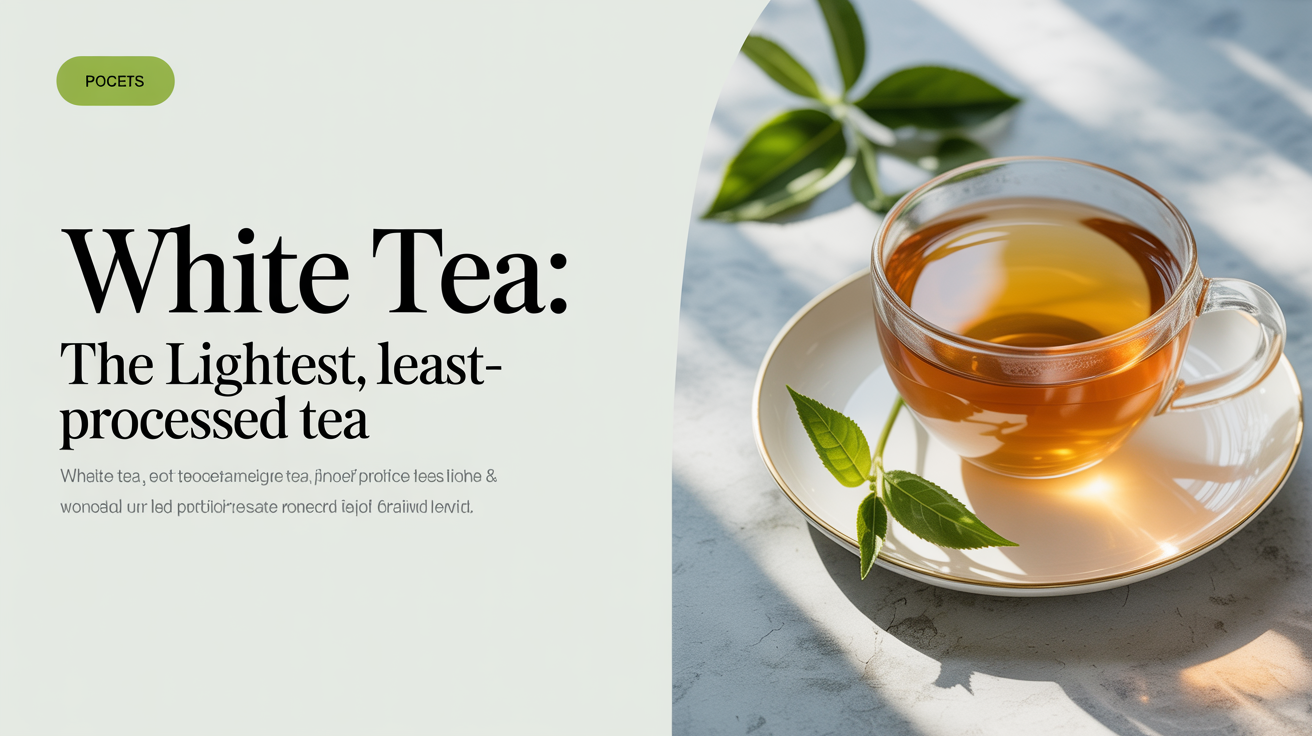
White tea is the simplest tea you can make: pick the leaf, wither it, dry it. No pan-firing, no rolling, no oxidation step. That restraint is why a cup of Silver Needle tastes almost nothing like a cup of black tea, even though both start from the same Camellia sinensis plant. The leaf does very little except lose moisture, which preserves compounds that heavier processing would otherwise destroy or transform.
That simplicity is deceptive. The range within white tea is wider than most people expect. A young Silver Needle brewed at 70°C is floral and almost sweet; a ten-year-old Shou Mei brewed at a full boil is woody, fruity, and closer in character to a mild pu-erh. Same category, completely different cups.
What Makes a Tea "White"
The term comes from the silvery-white hairs (called trichomes) on young, unopened buds. Those hairs are a natural defence against insects; they also contribute to the characteristic appearance of high-grade white tea.
Processing is the defining feature. Where green tea uses heat to stop oxidation immediately after picking, white tea skips that step almost entirely. The leaf is spread on racks, withered slowly in cool air for 24 to 72 hours, then dried, usually at low heat or in sunlight. Oxidation does occur during withering, but only slightly, typically 5 to 15 percent. The result sits well below oolong tea on the oxidation scale and far below black tea.
Most white tea comes from Fujian province in China, particularly the counties of Fuding and Zhenghe, each of which produces noticeably different styles using slightly different cultivars and withering methods. A small but growing amount now comes from Nepal, Sri Lanka, and Kenya, where results are mixed but some high-altitude producers are making genuinely good material.
The Main Types of White Tea
Silver Needle (Baihao Yinzhen)
Silver Needle is the benchmark. It uses only the unopened terminal bud, harvested in a narrow spring window, usually just a few weeks in late March and early April. Each bud is covered in white down and looks almost furry when dry. The cup is light-bodied, faintly sweet, and often described as melon, honey, or fresh hay. There is almost no astringency.
The bud-only harvest makes Silver Needle expensive and relatively rare. It is also the most forgiving on temperature. Some producers recommend as low as 70°C (158°F); others go up to 80°C (176°F). The lower end is safer if you want to keep the sweetness intact.
White Peony (Bai Mudan)
White Peony uses one bud plus one or two open leaves. This makes it more affordable and, to many palates, more interesting. The additional leaf material adds a mild grassy note and a touch more body. The cup is still gentle but has slightly more presence than Silver Needle.
Silver needle vs white peony is less a quality distinction than a style preference. Silver Needle is purer and sweeter; White Peony has a little more going on. For everyday drinking, White Peony is usually the better value.
Shou Mei and Gong Mei
Lower on the harvest ladder, Shou Mei and Gong Mei use more mature leaves picked later in the season, after the prime bud harvest. The leaves are darker, slightly larger, and more oxidised by the time they are dried. The resulting cup is fuller-bodied, sometimes fruity or earthy, with a mild astringency that the higher grades lack.
These are often overlooked in Western specialty tea circles, but they are workhorses in everyday Chinese consumption and are the usual starting point for aged white tea production.
Aged White Tea
White tea ages differently from other categories. Because it is not fixed by heat, enzymatic activity continues slowly during storage, and the tea keeps transforming for years or even decades. A well-stored three-year-old Shou Mei starts to develop dried fruit and tobacco notes. A ten-year cake can taste genuinely complex, with a long, warming finish.
The general rule is one year for a noticeable shift, three years for a meaningful change, and seven or more years before the tea is considered properly aged. Storage matters: a cool, dark, ventilated space with no strong odours. Airtight containers are wrong here; white tea needs to breathe slowly.
Aged white tea commands serious premiums, partly because of the storage cost and partly because quality at year ten is hard to predict from the leaf at year one. Buy from sellers who have documented storage histories.
Flavour Profile: What to Expect
The table below gives a quick reference across the main grades:
| Type | Leaf Used | Flavour Notes | Brewing Notes |
|---|---|---|---|
| Silver Needle | Bud only | Melon, honey, light floral | 70–75°C, 2–3 min, gentle |
| White Peony | Bud + 1–2 leaves | Fresh grass, mild sweetness, slight body | 75–80°C, 2–3 min |
| Shou Mei | Mature leaf | Fruity, earthy, mild astringency | 80–85°C, 2–4 min |
| Aged White (3+ yr) | Varies | Dried fruit, wood, tobacco | 85–95°C, multiple short steeps |
Factors that shift flavour noticeably:
- Cultivar. Fuding's Da Hao cultivar tends toward sweetness; Zhenghe's cultivar is slightly more vegetal.
- Season. Spring buds are sweetest. Autumn harvest can be good but has less of the delicate melon note.
- Storage age. Even one year of proper storage rounds off the raw edge on a younger Shou Mei.
- Water. Soft, low-mineral water (under 100 ppm TDS) makes a cleaner cup. Hard tap water can make white tea taste flat or slightly chalky.
How to Brew White Tea
Temperature
The temperature debate for white tea is real. The range commonly cited, 70–85°C (158–185°F), is wide because the right answer depends on the specific tea. Silver Needle is most forgiving of lower temperatures and most damaged by boiling water. Shou Mei and aged whites can handle and even benefit from hotter water.
A practical approach: start at 75°C (167°F) for any white tea you are brewing for the first time. If the cup tastes thin or grassy after two minutes, bump the temperature up 5°C on the next steep. If it tastes flat or papery, you may have gone too hot; try shorter steep time rather than lower temperature.
Western-Style vs. Gongfu
Western-style brewing means roughly 2 grams of leaf per 240 ml of water, 75–80°C, 2–4 minutes. This gives a straightforward cup. The problem is that white tea brewed this way often exhausts in two steeps.
Gongfu brewing uses a higher leaf-to-water ratio (4–6 grams per 100 ml is common) and very short steeps: 15–30 seconds for the first infusion, adding 10–15 seconds for each subsequent one. A good Bai Mudan or Silver Needle can give 6–8 distinct infusions this way, and the flavour changes meaningfully across them. The early steeps are lightest and sweetest; later steeps develop more depth.
Cold Brew
Cold brewing works well for white tea. Use 6–8 grams per litre of cold water, refrigerate for 6–12 hours, and strain. The result is very clean and sweet, with almost no astringency. It is a good method for Silver Needle if you want a refreshing summer drink without managing temperature.
Antioxidants and Health Claims
What is white tea actually doing for you? The honest answer is that the evidence is promising but thinner than the marketing suggests.
White tea does contain catechins, particularly EGCG, as well as caffeine and other polyphenols. Because it is less processed than green or black tea, some studies suggest it retains higher concentrations of certain antioxidants. A few laboratory studies, including one published in the journal Food Chemistry (2009), found that white tea extracts had comparable or slightly superior antioxidant activity to green tea extracts under specific test conditions.
The problem is that test-tube antioxidant capacity does not translate directly to measurable health outcomes in humans. The bioavailability of these compounds, how much actually reaches your bloodstream and tissues, depends on gut microbiome, individual metabolism, and what else you eat. Large-scale human trials on white tea specifically are sparse.
What is reasonable to say: white tea is a low-caffeine, low-calorie drink with a real polyphenol content, and drinking tea regularly is associated with positive health markers in population studies. The benefits are almost certainly real; the dramatic claims are not well-supported.
White tea contains roughly 15–30 mg of caffeine per 8 oz cup, compared to 20–45 mg for green tea and 40–70 mg for black tea. The lower caffeine makes it a practical option in the afternoon if you are sensitive to stimulants.
Frequently Asked Questions
What is white tea, exactly?
White tea is a minimally processed tea made from young buds and leaves of Camellia sinensis. The leaves are withered and dried with no pan-firing or rolling, which keeps oxidation very low. The name comes from the white hairs on the unopened buds.
Is white tea better for you than green tea?
"Better" is too broad to answer. White tea may retain slightly higher levels of certain antioxidants due to less processing, but green tea has been studied far more extensively in humans. Both are nutritionally similar and associated with the same general health markers. The difference in any meaningful sense is probably small.
How much caffeine is in white tea?
Less than green or black tea, but not zero. Expect 15–30 mg per 8 oz cup depending on the grade, brewing temperature, and steep time. Silver Needle tends to be on the lower end; Shou Mei a bit higher.
Can I reuse white tea leaves?
Yes, and you should. High-quality white tea is designed for multiple infusions. Silver Needle and White Peony hold up well for 4–6 western-style steeps or 6–10 gongfu steeps. Just do not let the wet leaves sit for more than an hour between steeps.
How should I store white tea?
Away from light, heat, strong smells, and moisture. An opaque, loosely sealed container in a cool cupboard works well. Unlike green tea, white tea does not need refrigeration and benefits from slow air exposure during long-term ageing. Avoid airtight sealed bags for anything you plan to keep longer than six months.