Types of Tea
Oolong Tea: The Whole Spectrum Between Green and Black
From floral jade oolongs to roasted rock teas, explore oolong tea types, flavors, and how to brew oolong at home.
Oolong sits in a category all its own. It's the only type of tea defined almost entirely by what its makers choose not to do: they start the oxidation process, then stop it somewhere in the middle. That range runs from 10% oxidation at the light end to around 85% at the dark end, which means the category stretches from something nearly indistinguishable from green tea to something approaching black tea in depth and color.
That width makes oolong harder to summarize than any other tea type, but it's also what makes exploring it genuinely rewarding. A light Taiwanese high-mountain oolong and a heavily roasted Wuyi rock tea are both oolong. They share a production method and almost nothing else in the cup.
What Makes a Tea an Oolong
All tea starts from the same plant, Camellia sinensis, and oxidation is the lever that separates the major types. With green tea, producers kill oxidation quickly through heat. With black tea, they let it run almost completely. Oolong sits in between.
After picking, the leaves are spread out to wither, then tumbled or shaken to bruise the edges. That bruising lets oxygen into the leaf cells and starts the chemical reactions that shift color and flavor. After the target oxidation window is reached, heat stops the process. The maker's judgment call on when to apply that heat determines whether the result drinks light and floral or dark and toasty.
Most oolongs also go through some form of shaping before drying. This is where the two major leaf styles come from: tightly rolled pellets (common in Taiwanese and Fujian oolongs) and long, twisted strips (typical of Wuyi rock teas and Dan Cong). That shape affects how the leaf unfurls during steeping, which matters for how you brew.
Light Oolongs: Jade and High-Mountain Styles
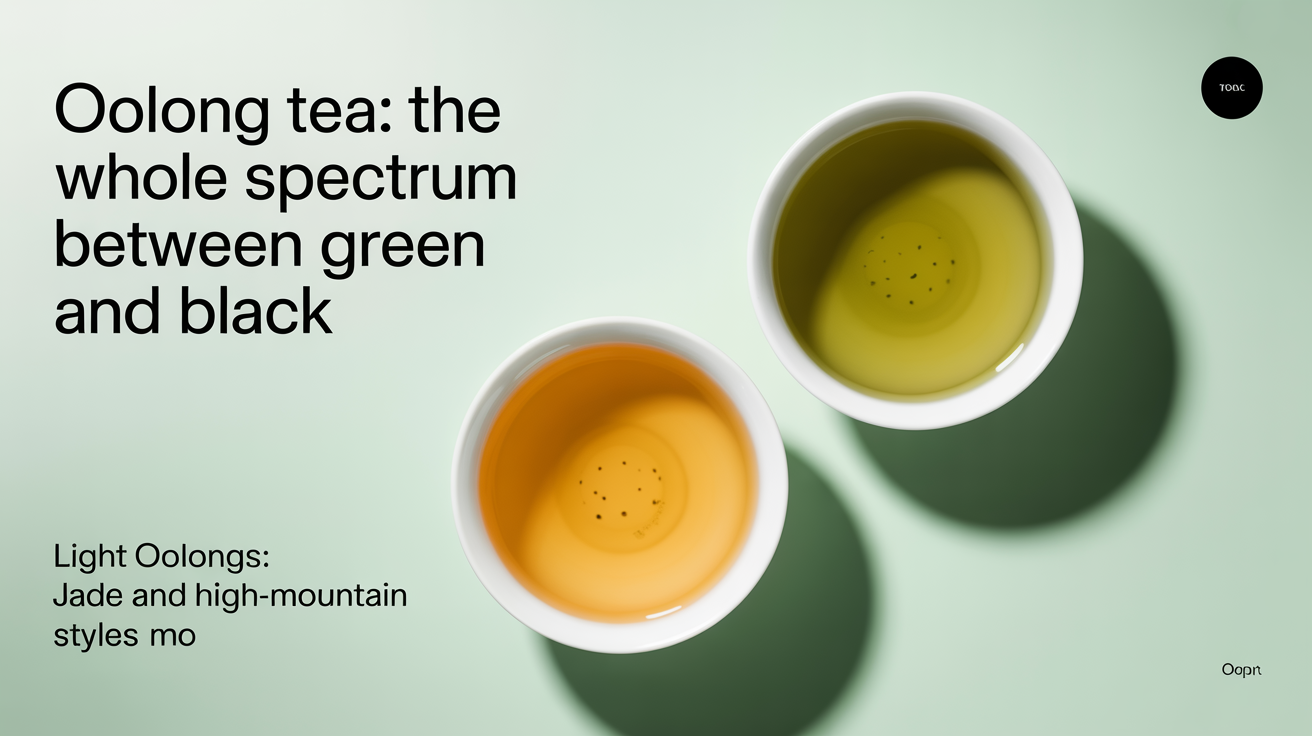
The lightest oolongs, oxidized anywhere from 10% to 30%, keep most of their green character. The flavor tends toward floral and vegetal, sometimes with a creamy finish.
Tieguanyin
Tieguanyin (Iron Goddess of Mercy) from Fujian's Anxi county is probably the most recognized light oolong in the world. The modern lightly oxidized style, often called "jade" or "green" Tieguanyin, is rolled into tight green pellets and brewed to produce a pale golden cup with orchid fragrance and a smooth, slightly milky texture. Older roasted versions of the same cultivar are quite different and belong in the dark category below.
Taiwanese High-Mountain Oolongs
Ali Shan, Li Shan, and Da Yu Ling are all grown at elevations above 1,000 meters in central Taiwan. High altitude means cool temperatures, slow growth, and concentrated flavor. These teas oxidize lightly (around 15--25%) and are rolled into tight balls. They brew up with a distinct floral sweetness, occasionally stone-fruit notes, and a clean, lingering finish. Da Yu Ling, grown at 2,500 meters, is the most prized and commands the highest prices.
Dark and Roasted Oolongs
Move to the other end of the spectrum and oolong gets richer, earthier, and sometimes intensely complex. Higher oxidation and additional charcoal roasting push these teas closer to black tea territory, though they retain a character distinctly their own.
Wuyi Rock Teas
Wuyi Yancha, from the rocky terrain of Fujian's Wuyi Mountains, are strip-leaf oolongs oxidized to 60--85% and often roasted multiple times over charcoal. The best-known varieties are Da Hong Pao, Rou Gui, and Shui Xian. They carry a mineral backbone that locals call "rock rhyme" (yan yun), layered with roasted grain, dark fruit, and sometimes cocoa. The roast character can be assertive when fresh; serious drinkers often rest freshly roasted Yancha for 3--6 months before brewing.
Dan Cong from Phoenix Mountain
Dan Cong oolongs grow in Guangdong province on tall, old trees. They're moderately oxidized (30--60%) and rarely heavily roasted. What makes Dan Cong strange and special is its aroma: individual cultivar lines are named after the scents they produce, and those names are not exaggerations. Mi Lan Xiang (Honey Orchid) genuinely smells of orchid and honey. Yu Lan Xiang (Magnolia) has an almost perfumey floral quality. Ya Shi Xiang (Duck Shit, despite the name) is one of the most prized. The strip leaves unfurl quickly and are sensitive to oversteeping.
Oolong Tea Flavor: What to Expect
Describing oolong tea flavor requires accepting that there's no single answer. The range from one end of the spectrum to the other is as wide as the gap between a Muscadet and a Barolo. Here's a quick reference:
| Style | Oxidation/Roast | Flavor Profile | Brew Notes |
|---|---|---|---|
| Jade Tieguanyin | 10--20% / unroasted | Orchid, green, creamy | Short steeps; 85°C |
| High-mountain Taiwan | 15--25% / light | Floral, stone fruit, sweet | 85--90°C; 4+ steeps |
| Dan Cong | 30--60% / variable | Fruity, aromatic, complex | 95°C; flash steeps |
| Traditional Tieguanyin | 30--40% / medium roast | Toasted, honey, deeper floral | 90--95°C; forgiving |
| Wuyi Yancha | 60--85% / heavy roast | Mineral, roasted, dark fruit | 95--100°C; rinse first |
| Aged oolong | variable / re-roasted | Earthy, woody, deep | 95--100°C; long steeps |
How to Brew Oolong
Gongfu brewing, using a small vessel and many short steeps, is the natural fit for oolong. It lets the leaves open gradually and shows off how each successive steep evolves. A good oolong should give you 5--8 usable infusions, with each one shifting in character.
The basics for gongfu oolong:
- Vessel: A 100--120 ml Yixing clay pot or gaiwan works well. Porcelain gaiwan is more neutral and better for tasting multiple teas fairly.
- Leaf ratio: Fill roughly 1/3 to 1/2 the vessel with dry leaf for rolled oolongs. Strip-leaf oolongs pack less efficiently; aim for around 5--7 grams per 100 ml.
- Temperature: Light oolongs do well at 85--90°C. Dark and roasted styles need 95--100°C to open properly.
- Steep times: Start with a 10--15 second first infusion. Add 5--10 seconds with each subsequent steep. Yancha benefits from a brief rinse (5 seconds, discard) to shed roast bitterness and wake up the leaf.
- Water: Filtered water with light mineral content. Hard tap water mutes delicate oolongs noticeably.
If gongfu feels like too much setup, you can brew oolong western-style in a regular mug or teapot. Use about 3 grams per 250 ml, 90°C water, and steep for 2--3 minutes. You'll lose the multi-steep dimension but the flavor is still there.
Rolled vs. Strip Leaf
Rolled oolongs take longer to open. In the first 1--2 steeps the balls are still partially closed, so flavor starts subtle and builds. Strip-leaf oolongs (Dan Cong, Yancha) unfurl immediately, which means the first steep can be the strongest. Flash steeps of 8--10 seconds are common for Dan Cong to avoid astringency.
This also affects how long they keep in a session. A tightly rolled high-mountain oolong can sustain 8+ steeps without flatting out. A strip-leaf Dan Cong might peak at 5--6.
Comparing Oolong to Other Tea Types
If you're already comfortable with green tea, a light Taiwanese high-mountain oolong is an easy step sideways: slightly more body, more pronounced sweetness, no bitterness if you keep the temperature at 85--90°C. If you drink black tea daily and want to branch out, a roasted Yancha keeps that depth and warmth but adds mineral complexity and handles multiple steeps instead of one. Those who enjoy white tea for its delicacy often find high-mountain oolongs a natural next step: more structure, comparable sweetness.
The broader point is that oolong rewards exploration in a way few categories do. A different style is genuinely a different drinking experience, not just a variation in intensity.
Frequently Asked Questions
What is oolong tea, exactly?
Oolong is a partially oxidized tea made from Camellia sinensis. Unlike green tea (minimal oxidation) or black tea (full oxidation), oolong is processed to stop oxidation partway through, anywhere from about 10% to 85%. The result is a tea that can taste floral and light or rich and roasted depending on where in that range the maker stopped.
How many types of oolong tea are there?
There's no fixed number. The main groupings are light/jade oolongs (Tieguanyin, high-mountain Taiwanese), medium oolongs (some Dan Cong, traditional Tieguanyin), and dark/roasted oolongs (Wuyi rock teas). Within each group there are dozens of cultivars and regional variations. Collectors focus on specific growing regions, harvest seasons, and roast levels.
Is oolong tea caffeinated?
Yes. Oolong generally contains 30--50 mg of caffeine per 8 oz cup, which puts it between green tea (20--40 mg) and black tea (40--70 mg). Heavily oxidized and roasted oolongs tend toward the higher end of that range.
Can you resteep oolong?
Repeatedly, and that's part of the point. Rolled oolongs typically give 5--8 good steeps when brewed gongfu. Strip-leaf styles like Yancha and Dan Cong usually give 4--6. Each steep tends to shift in flavor: earlier steeps bring aromatics, middle steeps develop body, later steeps often turn softer and sweeter.
How should oolong tea be stored?
Airtight container, away from light and strong odors. Most oolongs stay fresh for 12--18 months sealed. Heavily roasted Yancha is an exception: it often improves with some air time (1--2 weeks unsealed after purchase to let off-gases dissipate) and can age intentionally for years if stored carefully.