Brewing Methods
Western-Style Brewing: Getting the Most From a Single Steep
Learn how to brew tea western-style in a mug or pot: ratios, temps, timing, and tricks for a clean, full-flavored single steep.
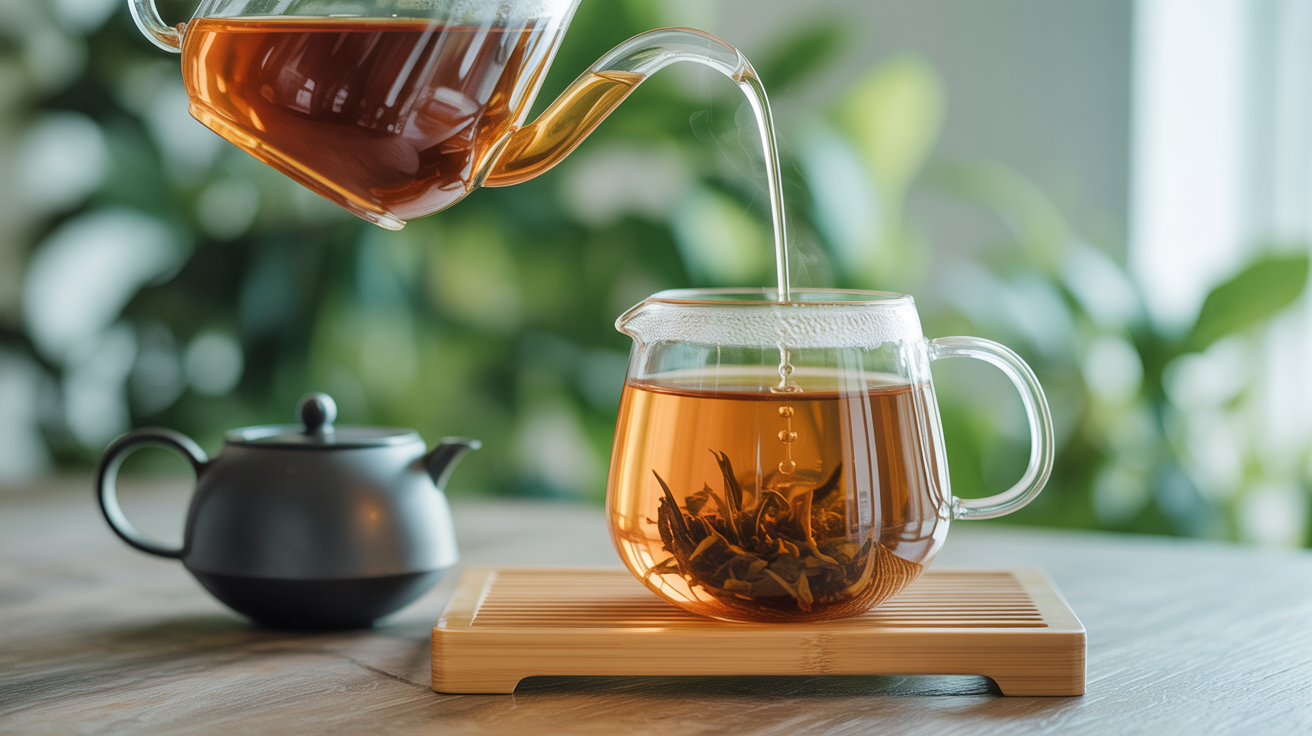
Most people brew tea the western way without ever calling it that. A teaspoon of leaves in a mug, water from the kettle, a few minutes on the counter. It is the default, the fast method, the one that fits into a morning before anything else does. Done carelessly it produces thin or bitter cups. Done with a little attention it produces some of the most satisfying tea you will drink all day.
Western style tea brewing uses less leaf and more water than its gongfu counterpart. Where gongfu cha packs a small vessel with 5-8 grams of leaf and runs a series of short 15-30 second steeps, the western single steep method puts 2-3 grams into a 250-350 ml mug and lets it sit for 2-4 minutes. One steep, sometimes two, and you are done. The advantage is simplicity; the cost is that you get less total volume from your leaves, and timing matters more.
What Western Brewing Actually Is
The term "western brewing" covers any approach that uses a high water-to-leaf ratio and a single steep or a small number of longer steeps. It developed as the dominant method in Europe and North America partly because of the tea types that arrived there, mostly black teas that extract quickly and hold up to longer contact with hot water.
The method scales from a single mug to a large teapot. The ratio stays roughly the same regardless of vessel size: about 1 gram of dry leaf per 100 ml of water, sometimes a little more for broken-leaf or fannings grades, sometimes a little less for a delicate whole-leaf white or green.
The Core Ratio and Why It Matters

Getting the leaf-to-water ratio right is the single biggest lever in western style tea brewing. Too little leaf gives you a thin, watery cup. Too much and the tannins overwhelm everything else during a long steep.
The standard starting point is 2-3 grams per 250 ml. Adjust from there based on the tea:
- Black tea (orthodox): 2-3 g per 250 ml, 95-100°C, 3-4 minutes
- Broken-leaf or CTC black: 2 g per 250 ml, 95-100°C, 2-3 minutes (extracts faster)
- Green tea: 2 g per 250 ml, 75-80°C, 2-3 minutes
- White tea: 3 g per 250 ml, 80-85°C, 3-4 minutes
- Oolong (light/green): 3 g per 250 ml, 85-90°C, 3 minutes
- Oolong (dark/roasted): 3 g per 250 ml, 90-95°C, 3-4 minutes
- Pu-erh (ripe/shou): 3 g per 250 ml, 95-100°C, 3 minutes
| Tea Type | Leaf : Water | Temp (°C) | Steep Time |
|---|---|---|---|
| Black (orthodox) | 2-3 g / 250 ml | 95-100 | 3-4 min |
| Black (CTC/broken) | 2 g / 250 ml | 95-100 | 2-3 min |
| Green | 2 g / 250 ml | 75-80 | 2-3 min |
| White | 3 g / 250 ml | 80-85 | 3-4 min |
| Oolong (light) | 3 g / 250 ml | 85-90 | 3 min |
| Oolong (dark) | 3 g / 250 ml | 90-95 | 3-4 min |
| Pu-erh (ripe) | 3 g / 250 ml | 95-100 | 3 min |
A kitchen scale is worth the space it takes up. Eyeballing a teaspoon works for some teas, but leaf density varies enough that the same volume of gyokuro and the same volume of broken Assam will weigh completely different amounts and need different treatment.
Mug vs. Teapot with an Infuser
The vessel changes the practical steps but not the underlying ratios.
Brewing in a Mug
How to brew tea in a mug, properly: put an infuser basket inside (mesh or perforated stainless), measure your leaf in, pour water at the right temperature, set a timer, and pull the infuser when time is up. That last step is non-negotiable. Leaving the leaves in contact with the water past the target time is the main cause of bitterness in western brewing.
A good infuser basket fits the full diameter of the mug so leaves can open and move. The tiny tea ball infusers with their two hinged hemispheres are awkward and restrict leaf expansion, which is particularly bad for large whole-leaf teas or anything that swells significantly, like white peony or rolled oolongs.
Brewing in a Teapot
A teapot with a removable infuser basket works on exactly the same principle but makes it easier to brew for two or three people at once. Scale the leaf proportionally: 6-8 grams for 600-750 ml. Pull the basket at the same elapsed time you would for a mug. If the pot has no strainer, pour all the liquid into cups or a decanting pitcher as soon as the steep is done so the leaves stop extracting.
How to Get a Clean Single Steep
A clean steep means the cup tastes balanced: enough body and flavor to be satisfying, no harsh bitterness, no papery thinness. A few things that help:
- Water quality. Filtered tap water or low-mineral spring water works well. Very hard water (above 200 mg/L total dissolved solids) dulls flavor and can make green teas taste metallic.
- Temperature accuracy. Green teas brewed at 95°C instead of 78°C will be bitter regardless of how short the steep is. A thermometer or a temperature-controlled kettle removes the guesswork.
- Preheating the vessel. Pour hot water into the mug or pot before adding the leaf, swirl, and discard. This keeps the brew temperature from dropping 5-10°C the moment hot water hits cold ceramic.
- Timer, not instinct. Two minutes feels like four when you are busy. Use the timer on your phone.
- Pull cleanly. Lift the infuser basket out and set it aside rather than pressing it against the side of the mug to squeeze out the last drops. That pressing motion extracts harsh compounds that would otherwise stay in the leaf.
Western vs. Gongfu Brewing: When to Use Each
This is not a competition. They are different tools.
Gongfu cha uses a high leaf-to-water ratio and very short steeps, repeated 6-12 times or more. It is an excellent way to explore a tea in depth, especially a complex oolong or aged pu-erh, because each successive steep reveals different layers. It requires time, equipment, and attention. You need to be sitting down and engaged.
Western style tea brewing is for the rest of the time. You want a full mug of tea. You have one kettle. You are going to drink it while reading or working. The single steep method is not a compromise; it is the appropriate method for that situation.
A few practical markers for choosing:
- Use western when you are brewing 250 ml or more, when you have 5 minutes not 45, when you are drinking plain black tea or a robust oolong, or when you want a hands-off process.
- Use gongfu when you want to explore a specific tea, when you have a high-quality oolong or sheng pu-erh worth drawing out over many steeps, or when the brewing itself is part of why you are drinking tea at the moment.
There is also grandpa style, which skips the infuser entirely and just adds leaf directly to the mug, drinking around them. It is even simpler than western brewing and handles certain teas, particularly white teas and light greens, quite well.
Getting a Second Steep
Most western-brewed teas can give a second steep, though it will be lighter. The general approach:
- After drinking most of the first cup, add hot water at the same temperature, but increase the steep time by 50-100%. A 3-minute first steep becomes a 4.5-5 minute second.
- For black teas, the second steep often has less astringency and a softer character. Some people prefer it.
- For green teas, a second steep at the same temperature can be bitter. Try dropping the temperature by 5°C.
- Light oolongs and white teas generally have enough soluble material for a good second steep, sometimes a third.
Cold water steeping is a different approach altogether. Cold brew tea puts a similar leaf quantity in cold water and extracts over 8-12 hours in the refrigerator. It produces a smooth, low-bitterness cup that suits certain teas well, particularly greens and whites.
If you are pulling a second steep, try not to let the first steep go too long. A 4-minute first steep on a black tea often leaves very little in reserve for a second.
Frequently Asked Questions
How much loose leaf tea per cup for western brewing?
The standard starting point is 2-3 grams per 250 ml of water. Black teas generally need 2-2.5 grams; whites and oolongs do well at 3 grams because the leaves are bulkier and lighter by volume. Weigh your leaf rather than relying on a teaspoon until you have a feel for the density of each tea you regularly use.
Why does my western-brewed tea taste bitter?
The two most common causes are water that is too hot (especially for green tea) and steeping too long. Green and white teas brewed at boiling temperature, or any tea left in the infuser well past the target time, will be bitter regardless of tea quality. Fix the temperature first (75-80°C for greens, 80-85°C for whites), then tighten your timing.
Can I use western brewing for high-quality teas?
Yes. The idea that expensive teas must be brewed gongfu-style is a preference, not a rule. A good Darjeeling first flush, a high-quality dragonwell, or a fine Taiwan oolong all produce excellent results western-style. The gongfu method reveals more complexity over many steeps, but a single well-brewed western cup of the same tea can be just as satisfying.
What is the difference between western and gongfu brewing?
The core difference is leaf-to-water ratio and the number of steeps. Western brewing uses 1 gram of leaf per 100 ml of water, a long steep (2-4 minutes), and typically one or two steeps total. Gongfu brewing uses 4-8 grams per 100 ml and steeps of 15-45 seconds, repeated many times. Western brewing is faster and produces more liquid per session; gongfu gives more control and more total flavor from the same leaves spread over a longer session.
Does the type of infuser affect the taste?
The material has minimal effect on flavor. The size and mesh fineness matter more. A basket infuser that allows leaves to expand fully will extract more evenly than a cramped ball infuser. Very fine mesh is better for small-leaf teas and broken grades so particles do not get through. For whole-leaf teas with large leaves, a coarser mesh or a simple strainer when pouring works fine.