Brewing Methods
Grandpa Style: The Simplest Way to Brew Loose Tea
Throw leaves in a cup, add hot water, keep topping up. Grandpa style brewing is the easiest way to brew loose tea — no gear needed.
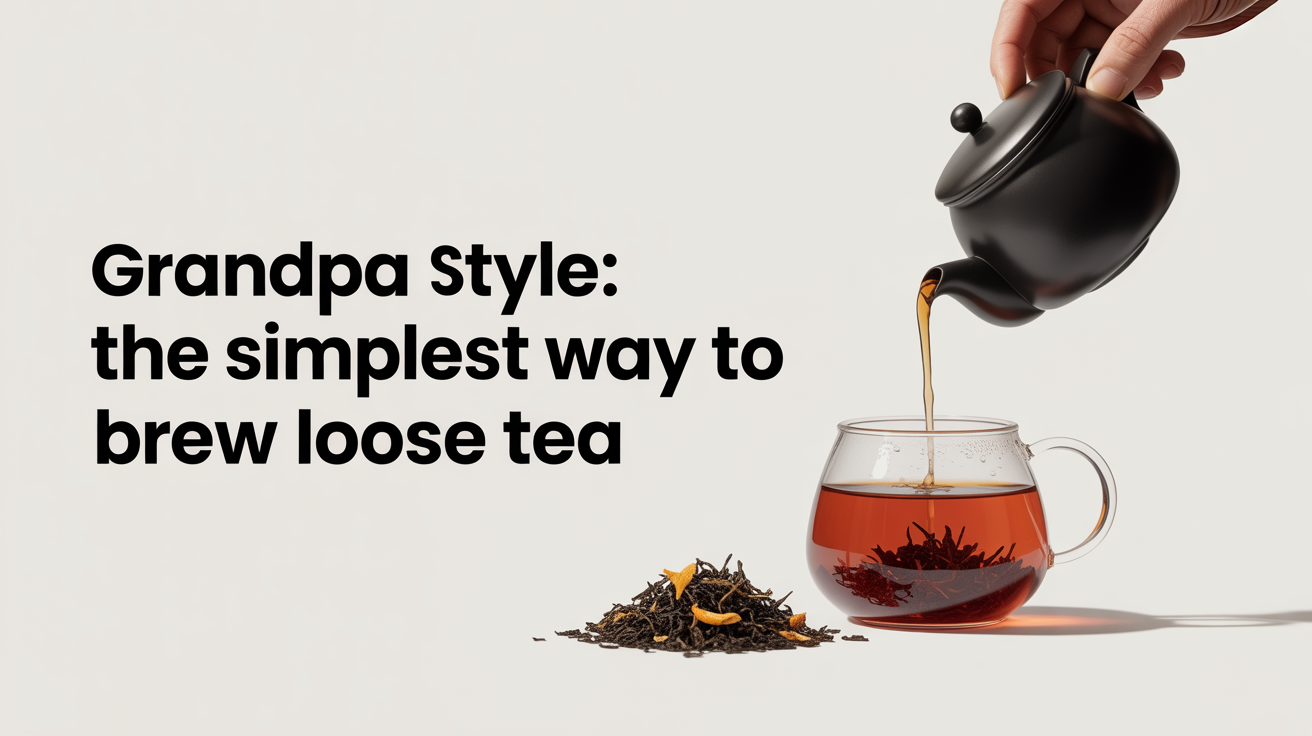
Put loose leaves in a cup. Pour hot water over them. Drink around the leaves. When the cup gets low, add more water. That's it. No strainer, no timer, no special vessel.
This is grandpa style brewing, and it has probably been used longer than any other method covered on this site. It sounds almost too simple to take seriously, but once you understand how it works, it becomes one of the most practical and satisfying ways to drink tea all day.
What Grandpa Style Is and Where It Comes From
The name comes from the image of an older Chinese tea drinker carrying a large glass jar or tall cup stuffed with tea leaves, perpetually refilling it with hot water throughout the day from a thermos or communal hot-water dispenser. You see it at offices in China, on long train journeys, and in parks where older men gather in the morning. Nobody is tracking steep times or measuring leaf ratios. The tea is always there, always changing in flavor, always ready.
In English-speaking tea circles, the term "grandpa style tea" was popularized by tea writers and vendors in the 2010s as a contrast to the more deliberate rituals of gongfu cha. Where gongfu cha uses small vessels, precise ratios, and many short steeps, grandpa style does none of that. The leaves sit in one large vessel all day. The flavor shifts from steep to steep, starting lighter and gradually deepening, then softening again as the leaves tire out.
It is worth noting that this is not a lazy or inferior method. It is a different relationship with the tea. You are not extracting every possible dimension in a concentrated tasting session. You are living with the tea over several hours, which has its own pleasures.
How to Brew Grandpa Style
The mechanics are simple, but a few small choices affect how well it works.
Choosing Your Vessel
Any cup or jar works, but a tall vessel helps. The height keeps most of the leaves settled at the bottom while you sip from the top. A 12-16 oz glass jar is ideal. A wide mug works too, though you will deal with more leaf movement. Clear glass is convenient because you can see the color of the liquor and judge when to add more water.
Leaf Amount and Water Temperature
Use more leaf than you think you need. For a 12 oz vessel, start with about 3-4 grams of whole-leaf tea. The leaves will hydrate, sink, and stay largely out of the way. Too few leaves and the first infusion is thin; too many and the early steeps can be bitter if you use boiling water.
Water temperature depends on the tea:
- Green tea and white tea: 160-175°F (70-80°C). This is critical. Boiling water on these teas, left in contact for hours, turns the cup astringent and unpleasant.
- Oolong: 185-205°F (85-96°C), depending on oxidation level. Lighter oolongs need lower temps; heavy roasted oolongs can take near-boiling.
- Sheng puerh (raw): 195-205°F (90-96°C). These leaves are tough and benefit from hotter water.
The Topping-Up Rhythm
There is no fixed rule for when to add more water. A rough guide: leave about 1-2 inches of liquid in the cup before refilling. This small amount of strong liquor blends with the fresh water and creates continuity between steeps. If you empty the cup entirely before refilling, each addition tastes like a fresh steep, which loses some of the gradual evolution that makes grandpa style interesting.
Most whole-leaf teas will give 4-8 comfortable refills before the flavor fades to plain water. At that point, the leaves have nothing left to give.
Which Teas Work Best
Not every tea suits the leaves-in-cup method. The best candidates share two qualities: whole or large-leaf structure (so they sink and stay down) and enough character to evolve across multiple dilutions without going sour or bitter.
Greens and Whites
High-grade whole-leaf greens are arguably the best grandpa style teas. Leaves like Long Jing (Dragonwell), Bi Luo Chun, and Tai Ping Hou Kui hold up beautifully across many steeps, and their grassy, sweet, vegetal notes shift in agreeable ways as the steeps progress. Lower water temperature is non-negotiable here.
Silver Needle and other white teas also do well. They are mild enough that there is little risk of over-extraction, and they reveal a quiet sweetness that intensifies by the third or fourth refill.
Oolongs
Ball-rolled oolongs like Tieguanyin or Jin Xuan are made for this. The tightly rolled pellets unfurl slowly, releasing flavor steadily over many steeps. Strip-style oolongs (like certain Wuyi rock oolongs) work too, though they open faster and may peak earlier.
Sheng Puerh
Young and aged raw puerh holds its own in a grandpa-style session. The compressed leaves take a few steeps to fully open, and the flavor complexity, ranging from bitter and vegetal in young sheng to earthy and sweet in aged, translates well to a long, slow session.
Teas That Don't Translate Well
| Tea Type | Works Grandpa Style? | Notes |
|---|---|---|
| Whole-leaf green (Long Jing, Bi Luo Chun) | Yes | Use cooler water; excellent choice |
| White (Silver Needle, White Peony) | Yes | Very forgiving, mild extraction |
| Ball-rolled oolong | Yes | Long, progressive session |
| Sheng puerh | Yes | Robust; ages well across steeps |
| High-fire roasted oolong | Usually | Strong enough to handle it |
| CTC black tea (breakfast blends) | No | Tiny particles over-extract immediately |
| Fine-cut black tea (most bags) | No | Becomes bitter within minutes |
| Shou puerh (ripe) | Sometimes | Can go muddy; test first |
| Flavored/blended teas | No | Additives behave unpredictably |
Fine or broken-leaf black teas are the main category to avoid. The small particles have enormous surface area relative to their mass. In a grandpa-style setup where leaves and water are in contact indefinitely, they turn bitter and astringent within minutes. Even a full-leaf Assam or Darjeeling can be tricky because black teas extract faster and less forgivingly than greens or oolongs. If you want an all-day session with black tea, cold brew is a more reliable option because cold water extracts slowly and gently.
Managing Leaves While You Drink
The practical concern most people raise is simple: how do you drink without getting a mouthful of leaves?
With practice, not much. A few approaches help:
- Tilt the cup gently before sipping so leaves drift away from the lip
- Use a vessel with a slight pour spout or drink from the side opposite where you added water
- Let the cup sit undisturbed for 30 seconds after adding water so the leaves resettle before drinking
- Sip, don't gulp; a small sip gives you a moment to feel leaves and redirect
You will get the occasional leaf in your mouth. Spit it out or swallow it. Tea leaves are harmless and in some traditions are chewed deliberately for their flavor. It stops feeling like a problem after a few sessions.
Grandpa Style at Work and on the Road
This is where the leaves-in-cup method earns its practical reputation. If your office has a hot-water dispenser or kettle, grandpa style is easier than any other brewing setup. No teapot, no filters, no timing. Bring a jar with a lid, load it with leaves in the morning, and refill from the hot-water tap throughout the day.
The same applies to travel. A wide-mouth insulated jar, 5 grams of good oolong, and access to a kettle covers you for a full travel day. The leaves sit in the jar, the lid keeps things warm, and the jar doubles as a cup. This is why grandpa style is genuinely the easiest way to brew loose tea in any environment without dedicated equipment.
For comparison, western-style brewing optimizes a single steep with a large infuser and a fixed brew time. It produces a consistent, well-extracted cup but requires measuring and timing, which is harder to replicate on the move. Grandpa style asks almost nothing of the environment.
Frequently Asked Questions
Can I use grandpa style with flavored teas or blends?
Generally not well. Added flowers, fruits, or spice oils behave unpredictably over many steeps. Some turn floral and odd; others become soapy or muted. The method works best with pure, single-origin whole-leaf teas.
How long can leaves sit in the cup before they go off?
If the cup has been sitting at room temperature for several hours without fresh water added, the wet leaves can develop off flavors. A good rule: if the cup has gone cold and you have not refilled in 3 or more hours, discard the leaves and start fresh. An active grandpa-style session with regular refills does not have this issue.
What size jar or cup is best for starting out?
A 12-16 oz clear glass jar is a good starting point. The height keeps leaves settled at the bottom, and clear glass lets you watch the infusion color. Mason jars work perfectly and cost almost nothing.
Does grandpa style waste tea?
It can, if you are using expensive gongfu-grade material and counting each gram. But for everyday drinking, a few grams of good oolong or green tea easily covers 6-8 cups across a morning. On a per-cup basis it compares favorably with most other methods.
Can I switch teas mid-session by adding new leaves to the same cup?
You can, but it gets confusing and the flavors compete. Better to empty the vessel, rinse it, and start fresh with new leaves. The grandpa style session is built around one tea and following it through its full arc.