Brewing Methods
Gongfu Cha: How to Brew Tea the Small-Pot Way
Learn gongfu cha brewing from gear to technique: small pots, high leaf ratios, short steeps, and why it changes what's in the cup.
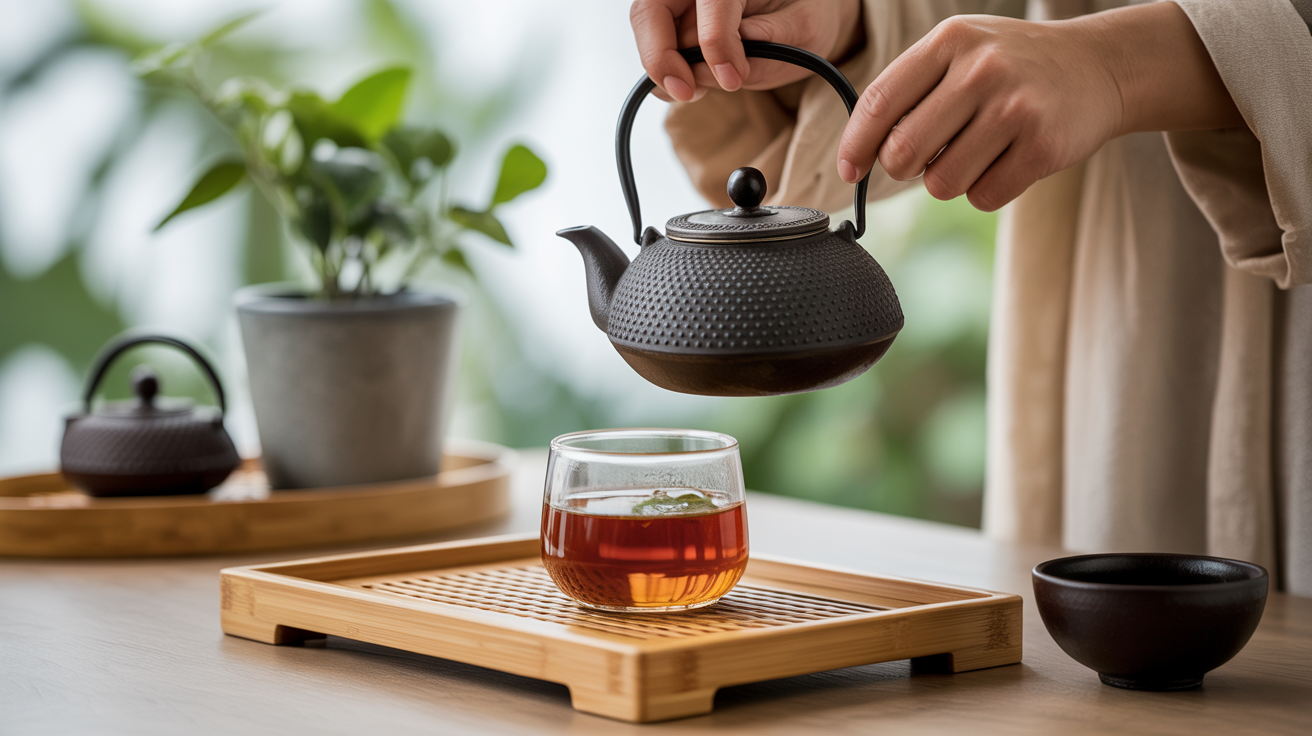
Gongfu cha brewing puts a lot of leaf into a small vessel, then pulls the liquor out fast, over and over again. A single oolong can give you eight to twelve distinct cups from one session, each one a little different from the last. If you've only ever made tea in a big mug or a standard teapot, this will feel like a different beverage entirely.
Quick answers
- The core flip from western brewing: much more leaf, much less water, much shorter steeps, repeated many times.
- Start around 1 gram of leaf per 10-15 ml of vessel, and 100-120 ml gaiwans are the easiest first vessel.
- First steep runs 15-20 seconds. Add 5-10 seconds per round as the leaves open and slow down.
- A fairness pitcher isn't optional gear you can skip. Without it, your first cup is weak and your last is stiff.
- Bitterness almost always traces back to water too hot, too much leaf, or a steep that ran long, not a bad tea.
The phrase "gongfu" (功夫) means skill applied through effort and repetition, the same word you'd use for martial arts mastery. Here it describes an unhurried, attentive approach to brewing where you pay close attention to each steep. That said, it's not a rigid ceremony that demands years of study. You can get excellent results in your kitchen with a few pieces of gear and a willingness to experiment. Tea historians generally trace this small-vessel style back to the 18th century, with competing claims for its birthplace between the Wuyi mountains in Fujian, where oolong production for export began, and the Chaoshan region of Guangdong, where it became part of everyday life.
What Gongfu Brewing Actually Changes
The difference comes down to ratio and contact time. Western-style brewing uses 2-3 grams of leaf per 200-250 ml of water and steeps for 3-5 minutes. Gongfu reverses those priorities: 6-10 grams of leaf per 100-120 ml of water, steeped for 10-45 seconds.
That compressed geometry extracts the tea in layers. First steeps pull forward aromatic compounds and light floral or fruity notes. Middle steeps bring out body and sweetness. Later steeps often shift toward earthiness, wood, or roasted character. You drink the tea's entire range rather than an averaged blend of everything.
The short steep time also controls bitterness. At high leaf ratios, even a 30-second oversteep can ruin a cup. That precision forces attention, which is partly why gongfu cha brewing has such a reputation for meditative focus.
Gear You Actually Need
You don't need an expensive collection to start. The core equipment is simple.
Brewing Vessel
The two main options are a gaiwan and a clay teapot.
A gaiwan (蓋碗) is a lidded bowl, usually 80-150 ml, made from porcelain or thick glass. It's neutral and easy to clean, which makes it the better choice for beginners and for anyone who brews multiple types of tea. You use the lid to hold back the leaves while you pour.
A clay teapot, often Yixing clay mined near Yixing city in Jiangsu Province since the Song dynasty, is porous and gradually seasons to the tea style you use most. The unglazed surface absorbs trace amounts of the tea over time, which is exactly why enthusiasts dedicate a single pot to a single tea type: mixing teas in one pot muddies the flavor the clay has been building up. They produce softer, rounder cups over time, but they're not a starting requirement.
For your first sessions, a gaiwan is the practical choice.
Full Gear List
- Gaiwan, 100-120 ml (porcelain or glass)
- Fairness pitcher (公道杯 / chahai), 150-200 ml, for decanting
- Small tasting cups, 30-50 ml, 2-4 of them
- Electric kettle with temperature control
- Small digital scale (0.1 g accuracy)
- Tea tray or a towel to catch drips
- A timer on your phone
The fairness pitcher matters more than it looks. You pour the steeped tea from the gaiwan into the pitcher immediately, which stops extraction and gives every cup the same concentration. Without it, the first cup poured is weaker and the last is stronger.
Leaf Ratio and Tea Selection
How Much Leaf to Use
The starting ratio for most gongfu cha brewing is 1 gram of leaf per 10-15 ml of vessel capacity. For a 100 ml gaiwan, that's 6-8 grams. Tightly rolled oolongs like Tie Guan Yin expand significantly when wet, so start at the lower end. Loosely rolled or open-leaf teas like Dan Cong or Wuyi rock oolongs can handle the higher end.
Adjust after your first session. If the tea tastes thin or the flavor disappears quickly across steeps, add a gram or two. If it's overwhelming or bitter, reduce slightly.
Which Teas Work Best
| Tea Type | Vessel Capacity | Leaf (grams) | Water Temp | Notes |
|---|---|---|---|---|
| Taiwanese oolong (ball-rolled) | 100 ml | 6 g | 90-95°C / 194-203°F | Expands 3-4× |
| Wuyi rock oolong | 120 ml | 8 g | 95-100°C / 203-212°F | Can handle boiling |
| Dan Cong oolong | 110 ml | 7 g | 90-95°C / 194-203°F | Aromatic, sensitive to heat |
| Shou puerh | 100-150 ml | 8-10 g | 100°C / 212°F | Rinse 2× before first steep |
| Sheng (raw) puerh | 100-150 ml | 7-8 g | 90-95°C / 194-203°F | Young sheng, lower temp |
| White tea (aged) | 120 ml | 6-7 g | 85-90°C / 185-194°F | Delicate; short steeps |
Green teas and fresh white teas can be brewed gongfu style but are less common. They're more sensitive to temperature and can turn bitter fast. You'll also get fewer steeps from them than from an aged or oxidized tea. If you want a simpler method for those, grandpa style is a lower-stakes option.
Water Temperature
Temperature matters a lot at high leaf ratios. Too hot for a delicate tea and the bitterness is concentrated by the ratio itself. Too cool and heavy oxidized teas never fully open.
Use temperature-controlled electric kettle and hit your target before you start. Don't estimate. Water that "looks hot" varies by 10-15°C depending on altitude and how long you've waited.
General guidelines:
- Lightly oxidized greens and whites: 75-80°C / 167-176°F
- Green and light oolongs: 85-90°C / 185-194°F
- Medium to heavy oolongs: 90-95°C / 194-203°F
- Wuyi, roasted oolongs, ripe puerh: 95-100°C / 203-212°F
Pour immediately once you hit temperature. Gongfu sessions move quickly, and water cooling in the kettle while you measure or fiddle with the gaiwan costs you more degrees than you'd expect.
Steep-Time Progression
The timing sequence is where gongfu cha brewing becomes a real skill. You start very short and add time as the session goes on, compensating for the fact that wet leaves extract slower than dry ones. Here's a working sequence for a medium oolong:
| Infusion | Time | Notes |
|---|---|---|
| Rinse (optional) | 5-10 sec, discard | Wakes leaves, removes dust; skip for delicate teas |
| 1st | 15-20 sec | Light, aromatic; don't expect full flavor yet |
| 2nd | 20-25 sec | Often the best cup |
| 3rd | 25-30 sec | Full flavor, body develops |
| 4th | 30-40 sec | Sweetness peaks on good oolongs |
| 5th | 45-60 sec | Flavor starts to shift; note the change |
| 6th-8th | 60-90 sec, increasing | Lighter, different character; can be as good as early steeps |
| 9th+ | 2-3 min | Extract what's left; often woody or mild |
These times are starting points, not rules. A Wuyi rock oolong might start at 10 seconds for the first steep. An aged shou puerh can go longer from the start because it's already been processed heavily. Keep notes in a small notebook. After a few sessions with the same tea you'll know its timing pattern.
Your First Gongfu Session, Step by Step
Here's how to run a complete session from setup to last cup.
1. Measure and heat water. Fill your kettle and set the temperature for your tea type. While it heats, weigh your leaf.
2. Warm the gaiwan and cups. Pour a small amount of hot water into the gaiwan, swirl, then pour it through into the fairness pitcher, then into the cups. Dump the water. This preheats everything and removes any storage odor.
3. Add leaf to the gaiwan. Look at it. Smell it dry. This is part of the practice.
4. Rinse (if the tea calls for it). Puerh and heavily processed oolongs benefit from a quick rinse. Cover the leaves just barely, put the lid on, and pour immediately into a waste bowl. Don't drink this steep. For fresh green oolongs or white teas, skip the rinse.
5. First steep. Pour water in a circle over the leaves, filling the gaiwan. Apply the lid. Start your timer. At the mark, hold the gaiwan with your thumb on top of the lid and two fingers on the base. Tilt the gaiwan so the gap between lid and bowl acts as a filter, and pour all the liquor into the fairness pitcher quickly. Leave no tea in the gaiwan.
6. Pour and drink. Fill each cup from the pitcher. Drink slowly; notice what's there.
7. Repeat. Add 5-10 seconds per steep. Continue until the flavor fades past the point of interest, usually 8-12 steeps for a quality oolong.
Adapting Gongfu Parameters to What You Have
You don't need a specific gaiwan. A small Japanese kyusu, a Turkish çaydanlık insert, or even a fine-mesh single-cup dripper can work as a starting point. The principles stay the same: high leaf ratio, short steep, complete drainage. Gongfu vessels in general run much smaller than a western teapot, typically 60 to 200 ml, which is part of what makes the high leaf-to-water ratio practical without brewing far more tea than you can drink in a sitting.
The most common mistake is under-leafing and over-steeping, which produces a cup that tastes like a weak, bitter version of western-brewed tea. Gongfu cha brewing needs enough leaf that the short steep time actually extracts something. If you're working with a container you're unsure about, start at 1 gram per 12 ml and adjust.
For comparison, cold brew runs in the opposite direction: very low leaf, very long time, cold water. Both produce complex, nuanced tea, but through entirely different mechanisms.
Frequently Asked Questions
Do I need a special gaiwan, or can I start with what I have?
Any small vessel with a lid and a way to strain the leaves works. A gaiwan is the most practical choice because it's easy to handle and clean, but a small clay teapot or even a well-sealed mug with a strainer will let you practice the technique while you decide whether to invest in proper gear.
How long does a full gongfu session take?
For 8-10 steeps, expect 30-45 minutes at a relaxed pace. Each steep takes under a minute of active brewing, but there's time between cups to smell the empty cup, notice how the aroma changes, refill the kettle if needed. You can also compress the whole thing to 15 minutes if you're after the tea and not the ritual.
What if my tea tastes bitter from the first steep?
Three likely causes: water too hot, too much leaf, or the steep was too long. For the next session, drop the temperature by 5°C, reduce leaf by a gram, or cut the first steep to 10 seconds. Usually one of those resolves it. If the tea is just a low-quality source, no parameter adjustment will fully fix that.
Can I use gongfu brewing parameters with bagged tea?
Technically yes, but the paper bag restricts leaf expansion, which defeats much of what makes gongfu style effective. Loose-leaf tea is the point. That said, if you cut open a high-quality bag and treat it as loose leaf, you can experiment with the technique.
How does gongfu compare to grandpa style for everyday use?
Grandpa style drops leaf straight into a cup or thermos with no straining, no equipment, no attention required. It's the lowest-friction way to drink loose leaf tea. Gongfu cha brewing gives you more from a better tea, but it takes time and focus. They serve different purposes. Most regular tea drinkers use grandpa style on weekday mornings and gongfu on weekends when there's time to slow down.
Further Reading
- Wikipedia: Gongfu tea ceremony covers the term's meaning and the competing accounts of where this brewing style originated.
- Wikipedia: Yixing clay has more on how the unglazed clay seasons with repeated use and why brewers dedicate one pot to one tea.