Types of Tea
The Six Types of Tea, All From One Plant
White, green, yellow, oolong, black, and pu-erh all come from Camellia sinensis. Learn how processing and oxidation create six completely different cups.
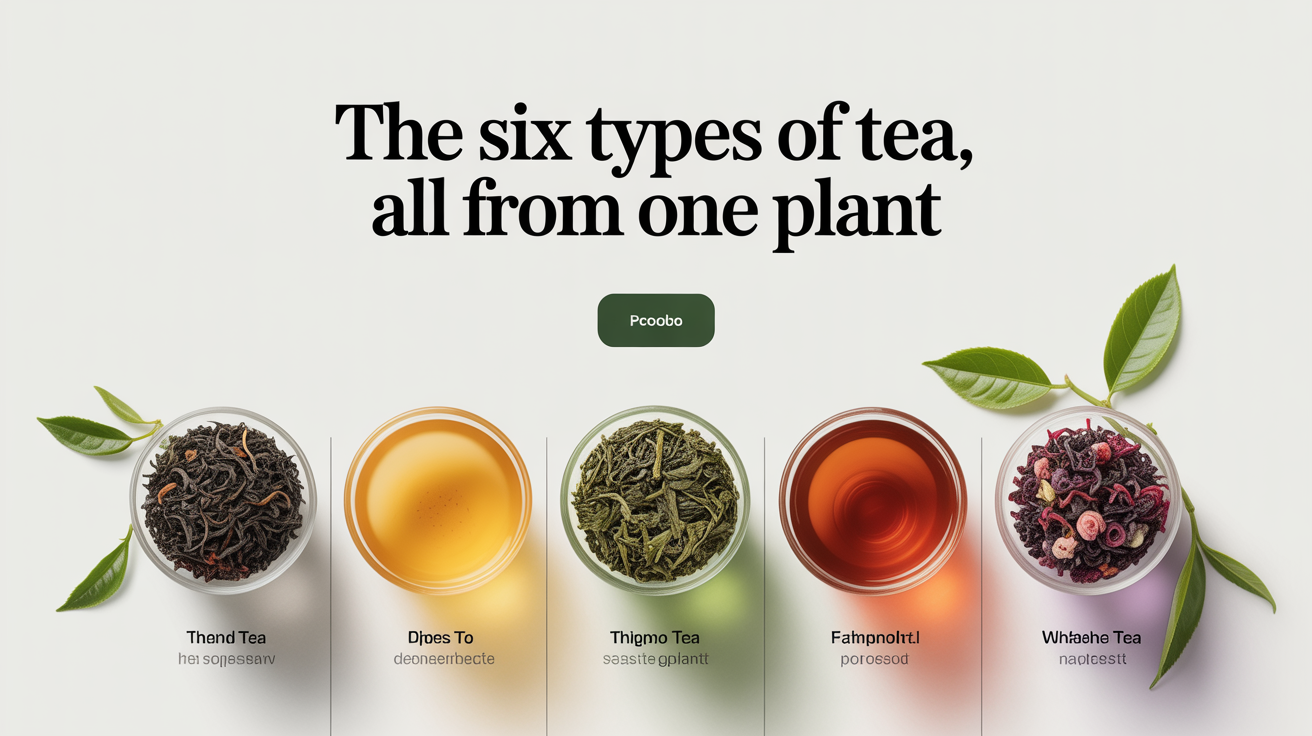
White, green, yellow, oolong, black, and dark (pu-erh) teas all come from the same plant: Camellia sinensis. The difference between a grassy Japanese green and a malty Assam black is not the plant, but what happens to the leaf after picking.
One Plant, Six Paths
Camellia sinensis is a subtropical shrub native to southwestern China and Southeast Asia. Every true tea (as opposed to herbal infusions made from other plants) is made from its leaves or buds. What separates the six types of tea from one another is how tea is processed: specifically how much the leaf is allowed to oxidize, and how heat is applied to stop that oxidation.
Oxidation is a chemical reaction. When a tea leaf is bruised or torn, enzymes in the cell walls contact oxygen and begin converting colorless compounds called catechins into darker, differently flavored molecules. Unoxidized leaves stay green. Fully oxidized leaves turn copper-brown and develop the malty, caramel notes typical of black tea. The six categories mark different points along that spectrum, plus one category (dark tea) that goes further still through microbial fermentation.
The Six Types, Explained
White Tea
White tea is the least processed of the camellia sinensis tea types. Fresh buds and young leaves are simply wilted and dried. There is no rolling, no heat fixation, and minimal oxidation, though some does occur during the slow air-dry. The result is a pale, delicate cup with flavors that range from fresh hay and melon to lightly sweet cream, depending on the cultivar and harvest.
Brewing white tea:
- Water temperature: 75-80 °C (167-176 °F)
- Leaf-to-water ratio: 2-3 g per 150 ml
- First steep: 2-3 minutes
- White tea handles multiple infusions well; add 30-60 seconds for each re-steep
Green Tea
Green tea is fixed early: the leaf is heated shortly after picking to deactivate the oxidation enzymes before they can do much work. In Japan, steaming is the standard method. In China, pan-firing is more common. Either way, the leaf stays green. Flavor profiles vary widely by origin and technique, from the fresh seaweed and umami of Japanese sencha to the lighter chestnut notes of Chinese Dragon Well (Longjing).
Because green tea retains a high concentration of catechins, it is sensitive to water temperature. Boiling water scalds the leaf and produces bitterness.
Brewing green tea:
- Water temperature: 70-80 °C (158-176 °F)
- Leaf-to-water ratio: 2-3 g per 150 ml
- First steep: 1-2 minutes (shorter for tender gyokuro, longer for robust Chinese greens)
- Works well for 3-4 infusions
For a closer look at the regional styles and how to brew each one, see our guide to green tea types, flavors, and brewing.
Yellow Tea
Yellow tea is rare and often left out of casual conversations about tea. The process is similar to green tea, but after heat fixation the damp leaf is piled and wrapped, allowing a slow, gentle change under warm, humid conditions. This step is called "men huan" (sealing yellow) in Chinese production. It smooths out the sharp edges common in green tea and produces a mellow, clean cup with hints of corn and light sweetness.
Authentic yellow tea such as Junshan Yinzhen or Mengding Huangya is produced in small quantities and can be hard to find outside specialist retailers.
Brewing yellow tea:
- Water temperature: 75-80 °C (167-176 °F)
- Leaf-to-water ratio: 2-3 g per 150 ml
- First steep: 2-3 minutes
- 2-3 infusions
Oolong Tea
Oolong sits between green and black on the oxidation spectrum, and it covers more ground than any other category. Oxidation levels range from roughly 15% to 85%. A lightly oxidized Taiwanese High Mountain (Gaoshan) oolong can taste almost like a floral green. A heavily oxidized Wuyi Yancha (rock oolong) brews roasted, mineral, and closer to a light black.
What makes oolong distinct is also the rolling and repeated partial-drying steps that concentrate and develop flavor. The result is a category with more internal variety than any other true tea type.
Brewing oolong tea:
- Water temperature: 85-95 °C (185-203 °F), lower end for greener styles and higher for roasted
- Leaf-to-water ratio: 4-6 g per 150 ml (oolongs are often brewed gongfu-style with a high leaf ratio and short steeps)
- First steep: 30-45 seconds gongfu style, 2-3 minutes Western style
- Oolongs are built for multiple infusions; 5-8 steeps is common
Our full guide to oolong tea across the spectrum between green and black covers the regional styles in more depth.
Black Tea
Black tea is fully oxidized. The leaf is withered, rolled to bruise it and accelerate oxidation, allowed to oxidize completely until the leaves turn copper-brown, then dried with heat to stop the process. The finished leaf is dark, and the cup brews to shades of amber and red-brown.
Flavor varies considerably by region. Assam (India) tends toward malt and briskness. Darjeeling first flush is lighter and muscatel. Yunnan Dian Hong is smooth with hints of cocoa. Sri Lankan Ceylon is often clean and citrusy. Black tea is the most forgiving of water temperature, which makes it practical for everyday brewing.
Brewing black tea:
- Water temperature: 90-100 °C (194-212 °F)
- Leaf-to-water ratio: 2-3 g per 150 ml
- First steep: 2-4 minutes
- Usually 2-3 infusions; robust varieties like Assam hold up well to milk and sugar
Our guide to black tea by region and style goes deeper on what to expect from each origin.
Dark Tea and Pu-erh
Dark tea is the sixth category and the one most unlike the others. After processing, the leaf undergoes microbial fermentation. In Yunnan province, this produces pu-erh, the most well-known dark tea. Pu-erh can be aged for years or decades, and the fermentation happens either slowly over time (raw, or sheng, pu-erh) or is accelerated in a controlled pile fermentation process (ripe, or shou, pu-erh).
Shou pu-erh brews dark, earthy, and smooth. Aged sheng pu-erh can taste woody and dried-fruit, with layers that shift across multiple infusions. Other dark teas from Hunan (Liu Bao) and Sichuan follow similar fermentation principles but have their own character.
Brewing pu-erh:
- Water temperature: 95-100 °C (203-212 °F)
- Leaf-to-water ratio: 5-6 g per 150 ml gongfu style, or 3-4 g for Western brewing
- Rinse the leaf with hot water for 5-10 seconds and discard before the first real steep
- First steep: 20-30 seconds gongfu; 2-3 minutes Western
- Good aged pu-erh can go 10 or more infusions
Brewing at a Glance
| Tea Type | Oxidation | Water Temp | Steep Time | Infusions |
|---|---|---|---|---|
| White | Minimal | 75-80 °C | 2-3 min | 3-4 |
| Green | None | 70-80 °C | 1-2 min | 3-4 |
| Yellow | Very low | 75-80 °C | 2-3 min | 2-3 |
| Oolong | 15-85% | 85-95 °C | 30 s to 3 min | 5-8 |
| Black | Full | 90-100 °C | 2-4 min | 2-3 |
| Dark / Pu-erh | Full + fermented | 95-100 °C | 20 s to 3 min | 5-10+ |
Frequently Asked Questions
Are herbal teas part of the six categories?
No. The six types of tea all come from Camellia sinensis. Herbal infusions such as chamomile, peppermint, hibiscus, and rooibos are made from entirely different plants. They are often called tisanes to distinguish them. Because they contain no Camellia sinensis leaf, they do not fit the oxidation-based categories above.
Does more oxidation mean more caffeine?
Not necessarily. Caffeine content in the leaf is determined largely by cultivar, growing conditions, and which part of the plant was picked. Young buds and first leaves carry more caffeine than older leaves. Processing does not create or destroy caffeine in a meaningful way. A pu-erh brewed with a high leaf ratio can deliver more caffeine per cup than a lightly brewed white tea, but that has more to do with the volume of leaf used than the oxidation level.
Can I use the same water temperature for all six types?
You can use similar equipment, but the temperature matters for each category. Using boiling water on green or yellow tea will produce sharp bitterness because the heat pulls harsh compounds from the undamaged cell structure. Water that is too cool for black or pu-erh often produces a flat, thin result. The table above gives a reliable starting range for each type.
What does "first flush" mean on a tea label?
Flush refers to the harvest cycle. First flush is the earliest spring picking; second flush comes a few weeks later. The term is most commonly used for Darjeeling black teas, where first flush (March to April) produces lighter, more aromatic leaves and second flush (May to June) brings the fuller-bodied muscatel character. The term also appears on teas from other parts of the Indian subcontinent.
Is pu-erh the same as aged tea?
Not exactly. Any tea can be stored over time, but pu-erh is the only category specifically made for long aging through active microbial fermentation. An old green tea or white tea may simply fade. Properly stored raw pu-erh continues to change and can develop more complexity over decades because the microbial activity continues slowly as long as storage conditions are right.