Teaware & Ritual
Tea Infusers and Strainers: What Actually Works
Cut through the gadget noise: which tea infusers and strainers actually let the leaf breathe and brew properly.
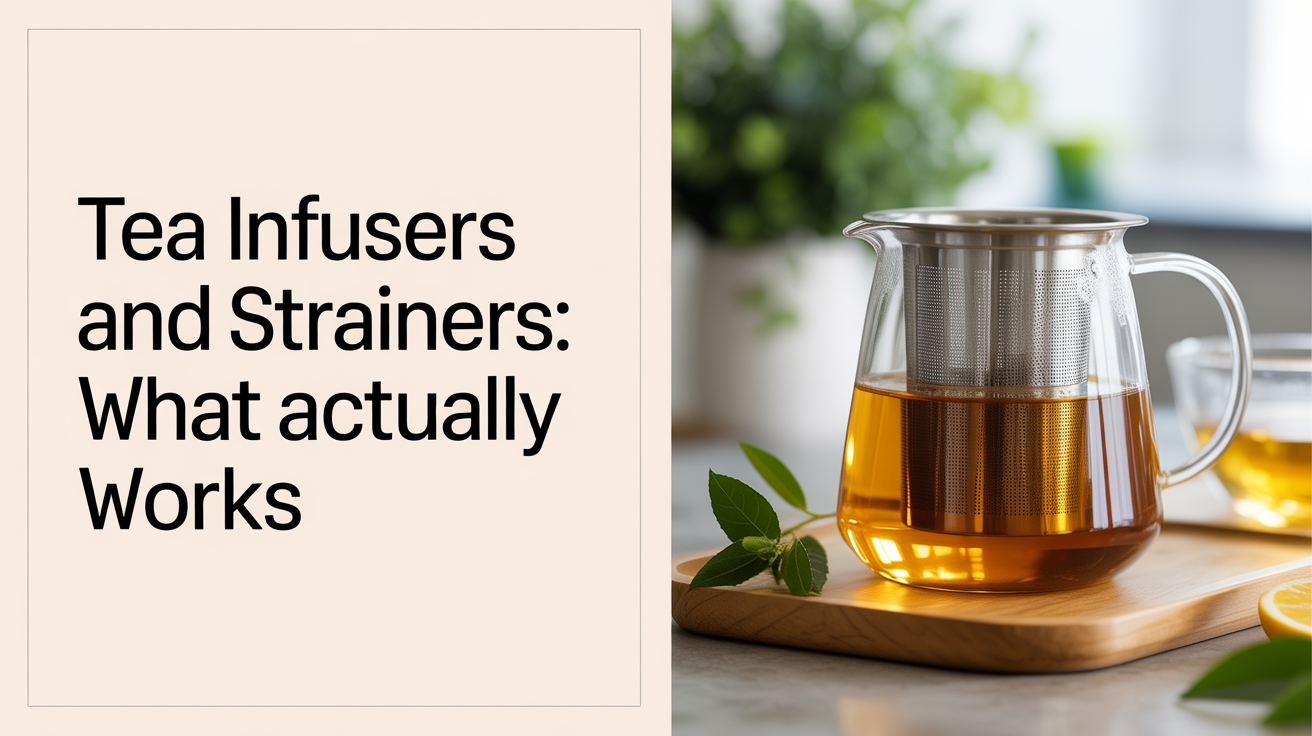
The single most common loose-leaf mistake has nothing to do with water temperature or steeping time. It's cramming good tea into a tiny mesh ball and wondering why it tastes flat. Leaves need room to expand, sometimes doubling or tripling in volume as they unfurl. Restrict that movement and you get a muted, astringent cup regardless of how carefully you sourced the tea.
Picking the right infuser or strainer is genuinely simple once you understand what each tool is actually doing, and why some popular options work against you.
Infuser vs Strainer: They Are Not the Same Thing
People use these words interchangeably, but the tools solve different problems.
What an Infuser Does
An infuser holds the leaf inside the cup or pot during steeping. You put tea in, pour water over, and remove the whole basket or ball when time's up. The leaf stays contained throughout. Good for single-session brewing where you want a hands-off process.
What a Strainer Does
A strainer sits over a cup and you pour brewed liquid through it. The leaf stays in the pot or gaiwan; the strainer just catches whatever escapes during pouring. This is the standard approach in Chinese and Taiwanese brewing, and it's the best way to strain loose tea if you're using a vessel without a built-in filter.
Both have legitimate uses. The choice depends on your vessel and how you want to brew.
Why Small Basket Balls Underperform
The ubiquitous stainless ball infuser, the kind sold in every kitchen shop for a few dollars, is almost always too small. Even a large one caps out around 1.5 inches in diameter, which gives a rolled oolong or a twisted Yunnan black maybe half the space it needs. The outer leaves steep, the inner leaves barely get wet, and everything gets compressed as they try to open.
There's also a flow problem. Tightly woven mesh slows water circulation. In a small ball, the water that does get in sits in a semi-stagnant pocket rather than moving through the leaf mass. You end up with a weak, uneven extraction.
A tea infuser for loose leaf only earns its place if it's large enough that the leaf is never packed in.
The Types Worth Owning
Large Basket Infusers
A wide, deep stainless basket that drops into a mug or teapot is the practical everyday solution. Look for ones at least 2.5 inches across with walls deep enough that the leaf has vertical room too. The mesh gauge matters: fine enough that fannings and broken pieces don't slip through, but not so fine that it clogs after one steep. A medium weave handles most teas well.
Finum, Rishi, and a handful of others make baskets in this category. They rinse quickly and last for years.
Fine-Mesh Pour-Over Strainers
For multiple short steeps, a small strainer you pour through is faster and easier than removing and rinsing a basket between rounds. These are inexpensive, easy to clean, and don't require you to match a basket size to your vessel.
The downside is that they require a separate steeping vessel. If you're brewing in a mug, you need somewhere to pour from. If you're already using a gaiwan or teapot, a pour strainer slots in naturally.
The No-Gadget Method: Gaiwan and Decant
The simplest approach, and one that produces consistently clean results, is to brew in a gaiwan or unglazed pot and pour directly through a strainer into a separate pitcher. No infuser basket required. The tea has the entire vessel to expand. Extraction is even because water moves freely through the leaf mass. Pouring through a strainer takes two seconds.
This is how most serious tea drinkers brew because it removes one variable. The vessel does the work; the strainer just keeps sediment out of the cup.
Materials: What Actually Matters
Stainless Steel
The default for good reason. Neutral taste, durable, easy to clean. The main variable is mesh quality. Stamped mesh with welded seams holds up better than woven mesh that can fray. For most people, stainless is the answer.
Silicone-Coated or Plastic
Fine for travel, less ideal at home. Some plastics retain odors after a few months of daily use, which matters if you rotate between delicate whites and assertive blacks. Not a dealbreaker, just something to test.
Silver and Gold-Plated Mesh
Sold as premium options, these work fine but don't perform differently from uncoated stainless. Save your money unless you like the look.
Ceramic and Porcelain Built-In Filters
A number of Japanese kyusu and Chinese pots have a ceramic or porcelain filter built into the spout. These work beautifully with larger-leafed teas but let fine dust through. Pairing one with a secondary mesh strainer solves the problem.
What to Avoid
Novelty shapes. Rubber duckies, robots, and mushroom-shaped infusers are designed to look charming, not to brew well. The internal volume is usually tiny and the mesh is often too coarse on one end and too fine on the other.
Single-serving travel infuser mugs with attached lids. The mesh is almost always too small, and there's no way to remove the leaf promptly, so the tea keeps steeping while you drink. You get an increasingly bitter cup from a single steep rather than clean multiple infusions. If you're using a variable-temp kettle to nail temperatures, a travel mug that over-extracts undoes that work immediately.
Very fine mesh baskets for silver needle or other downy whites. The fine hairs on white tea clog tight mesh quickly. A slightly more open weave, or a strainer with a wider surface area, is better.
Comparison: Main Types at a Glance
| Type | Pros | Cons | Best For |
|---|---|---|---|
| Large basket infuser | Stays in cup/pot; hands-off; easy | Must size to vessel; needs rinsing between steeps | Daily mugs; casual brewing |
| Small ball infuser | Cheap; widely available | Too small for most teas; poor extraction | Short teas, rooibos, herbal blends only |
| Fine-mesh pour strainer | Fast; works with any vessel; cheap | Needs separate brewing vessel | Multiple short steeps; gongfu style |
| Built-in ceramic filter (kyusu) | No extra tools; elegant | Lets fines through; fixed to one pot | Larger-leaf Japanese greens |
| Gaiwan + strainer (no basket) | Maximum leaf room; cleanest extraction | Slight learning curve; two vessels needed | Serious brewing; oolongs; puerh |
Quick Recommendation List
- For a single mug at your desk: A wide stainless basket infuser, at least 2.5 inches across. Finum makes a reliable one.
- For multiple steeps from one session: A small mesh pour strainer and a gaiwan or small pot. Fastest workflow for gongfu-adjacent brewing.
- For a teapot you already own: A pour strainer is often better than a basket, especially if the pot has a wide mouth.
- For travel: Accept the compromise of a travel mug basket, but steep short and drink promptly. Don't let the leaf sit.
- For unglazed pots like yixing: No infuser at all. Brew and pour through a strainer. The porous clay is part of the process and requires its own care anyway; don't interfere with metal baskets.
Cleaning and Maintenance
Rinse immediately after use. Wet leaf left in mesh for more than an hour starts to stain, and tea tannins bond to steel faster than you'd expect.
For stainless baskets, a weekly soak in hot water with a small amount of baking soda removes tannin buildup without affecting taste or the mesh coating. Avoid dish soap with strong fragrance if you can; it's not dangerous, but some basket weaves hold scent.
Fine-mesh strainers benefit from occasional scrubbing with a soft brush. A toothbrush works. Most stains come out; the ones that don't are cosmetic and don't affect performance.
Silicone grommets on some basket handles should be dried separately. Trapped moisture under the grommet is the only place on a steel infuser where rust is a real possibility.
Frequently Asked Questions
What is the actual difference between a tea infuser and a tea strainer?
An infuser holds the leaf inside the brewing vessel while the tea steeps. A strainer is used after steeping, to filter the liquid as you pour. You can use one or both depending on your setup. Most gadget-style accessories are infusers; the small mesh baskets you hold over a cup are strainers.
Is a tea strainer vs infuser a meaningful choice, or does it not matter much?
It matters if you're doing multiple short steeps, which is standard for oolongs, puerh, and most greens. An infuser requires removal and rinsing between steeps; a pour strainer lets you leave the leaf in place and just pour. For single long steeps of black tea in a mug, an infuser is simpler.
What is the best way to strain loose tea without buying a lot of equipment?
A small fine-mesh strainer over a cup, used with any heat-safe vessel you already have, is all you need. A mason jar or a simple ceramic mug works as a brewing vessel. Pour through the strainer, done. You don't need a dedicated teapot or a basket infuser to get a good cup.
Can I use a tea ball for high-quality oolongs or greens?
Not well. Rolled oolongs in particular expand significantly as they open, and a ball infuser doesn't give them space to do that. You'll get a noticeably weaker cup than the same leaf brewed in a large basket or open vessel. For premium tea, the small ball is the wrong tool.
How often should I replace a mesh infuser or strainer?
A quality stainless basket lasts years with basic care. Replace it when the mesh shows holes or the seam where mesh meets frame starts to separate, which allows leaf to escape. Cheap ball infusers tend to show wear within a few months if used daily. The basket style is more durable because the mesh is under less mechanical stress during normal use.