Tea Basics
Loose-Leaf vs. Tea Bags: What's Actually the Difference
Comparing loose leaf tea and tea bags across leaf grade, flavor, cost per cup, and convenience so you can decide which makes sense for your brewing routine.
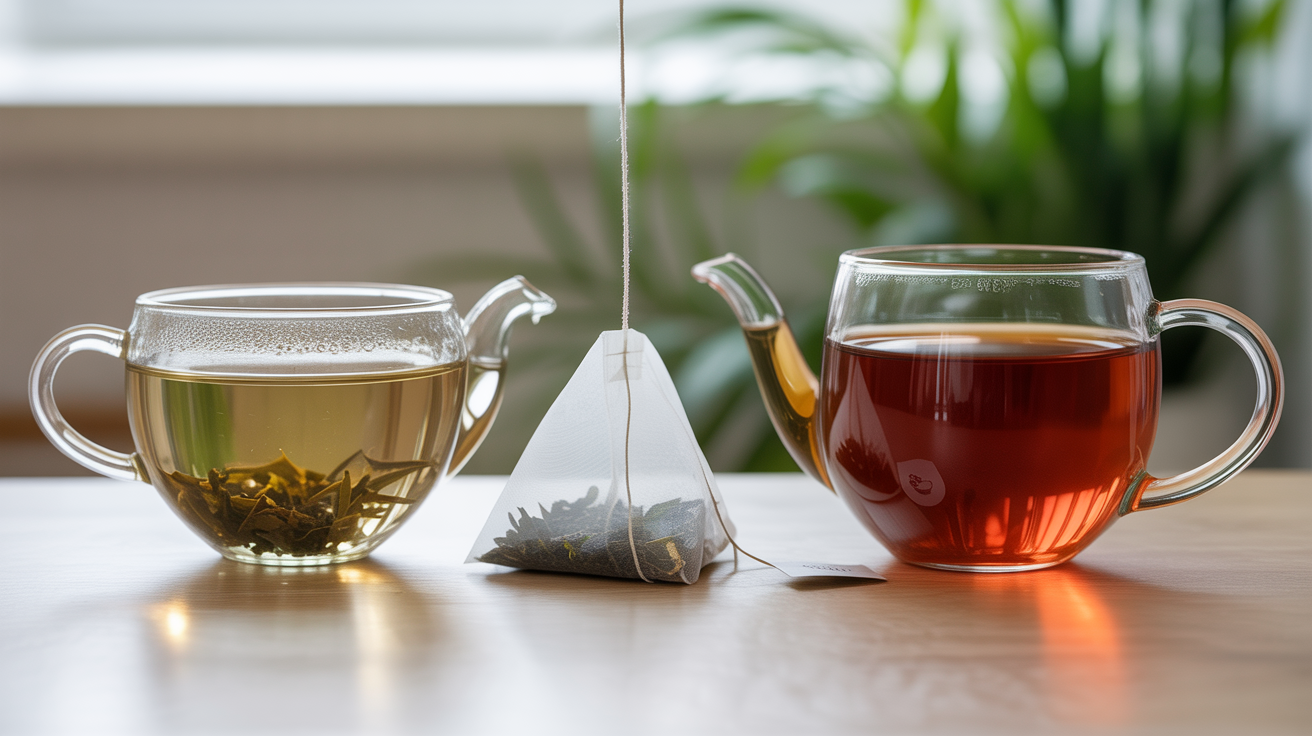
Loose-leaf tea and tea bags are made from the same plant, but the way the leaf is processed and packed changes what ends up in your cup in a few concrete ways. Here is what those differences actually are.
What Goes Inside a Tea Bag
Standard tea bags are filled with what the industry calls "fannings" or "dust," the tiny particles and broken pieces left over after whole leaves are sorted and graded. These fragments have a very high surface area relative to their mass, which means they release flavor and color into hot water quickly. That is the main engineering purpose of the small, fine cut: fast extraction in under three minutes.
Whole-leaf or loose-leaf tea is made from larger, intact leaf pieces or buds. These are typically graded higher on the scale used in the tea trade (terms like OP, or Orange Pekoe, refer to leaf size rather than flavor or origin). Higher grades are not always better in some abstract sense, but larger leaves carry more of the aromatic oils and volatile compounds that give teas their character.
Specialty tea bag formats (pyramid sachets, large cloth bags) exist to bridge this gap. They give the leaf room to swell and open, which is why a quality pyramid sachet can taste closer to a cup brewed from loose leaf. If you buy bagged tea, this format is worth paying attention to.
Flavor and Room to Expand
Leaf size matters to flavor because of how tea extracts. When a whole leaf sits in hot water, it unfurls gradually, releasing compounds at different stages of the steep. A broken fannings-filled bag extracts most of what it has to give in the first 90 seconds. This is not necessarily a flaw: it produces a consistent, punchy cup that stands up to milk and sugar, which is why breakfast blends are almost always made from fannings.
What loose leaf offers is more range. A high-grade Darjeeling first flush, an aged oolong, a silver needle white tea: these teas have layers of flavor that only come through when the leaf has space to open fully in the water. Brewing them in a cramped bag would flatten exactly what makes them worth buying.
This is where how to brew loose-leaf tea matters practically. A gaiwan, a loose infuser, or a teapot with a basket strainer all give the leaf room to move. The brewing vessel is not decorative; it is part of the extraction equation.
For day-to-day mornings, a well-sourced teabag from a quality producer is a reasonable choice. The gap between a generic supermarket bag and a thoughtfully sourced bagged tea is larger than the gap between a good bagged tea and loose leaf of equivalent grade.
Cost per Cup
Loose-leaf tea typically costs more per package but less per cup. Here is a rough structure to illustrate the comparison (actual prices vary by origin, grade, and supplier):
| Format | Typical package | Leaf per cup | Cups per package |
|---|---|---|---|
| Standard teabags (2 g each) | 20-bag box | Fixed | 20 |
| Loose leaf, mid-grade | 50 g bag | 2-3 g | 17 to 25 |
| Loose leaf, mid-grade | 100 g bag | 2-3 g | 33 to 50 |
| Pyramid sachets (2.5 g each) | 15-bag box | Fixed | 15 |
The math shifts further when re-steeping is possible, which is covered in the next section. A 3-gram portion of whole-leaf oolong that gives three good infusions costs a fraction per cup compared to a single-use teabag.
The cost advantage of loose leaf is most apparent when you buy in 100-gram quantities and use a kitchen scale to measure. Getting the leaf-to-water ratio right also ensures you are not over-using leaf, which is one common way people accidentally make loose leaf more expensive than it needs to be.
Convenience: Where Tea Bags Win
Tea bags exist because they are fast, mess-free, and disposable. For office desks, travel, shared kitchens, or any situation where you do not want to carry a strainer, they solve a real problem. No weighing, no rinsing equipment, no loose leaves to dispose of.
Loose leaf requires at least one piece of equipment: a strainer, infuser, or pot with a basket. It adds roughly 60 seconds to prep and cleanup. For most people who start brewing at home, these are manageable. But they are real factors for certain routines.
A practical comparison:
Tea bags
- No equipment needed
- No measuring required
- Travel-friendly
- Consistent dose every time
- Disposable, nothing to clean
Loose leaf
- Requires a strainer or infuser
- Needs measuring (or at least a rough scoop)
- Takes slightly longer to prep and clean
- More control over dose and steep time
- Less packaging per serving
Neither list is a verdict. Many tea drinkers keep bags for weekday mornings and loose leaf for slower weekend sessions. Both habits make sense.
Re-Steeping
This is one of the clearest practical advantages loose-leaf tea holds over bags. Most whole-leaf teas (oolongs, greens, whites, many blacks) can be steeped two to four times from a single measure of leaf. Each infusion is different: the first steep is often lighter, the second fuller, and the third more subtle.
Tea bags can technically be re-steeped once, but because the leaf inside is already finely broken and largely extracted on the first pass, the second cup is noticeably thin. It is rarely worth it.
Re-steeping is especially meaningful for teas like Taiwanese oolongs or Chinese greens that are designed for repeated short infusions. Getting four or five good cups from 4 grams of leaf changes the economics considerably.
Getting water temperature right matters here: teas brewed at lower temperatures (green, white, lightly oxidized oolongs) hold up better across multiple steepings than teas brewed at full boil.
Side-by-Side Summary
| Factor | Tea bags | Loose leaf |
|---|---|---|
| Leaf grade | Fannings or dust (usually) | Whole or near-whole leaf |
| Flavor range | Consistent, fast-extracting | Wider range, depends on the tea |
| Equipment needed | None | Strainer or infuser |
| Time per cup | 2 to 3 minutes | 3 to 5 minutes |
| Cost per cup | Moderate to high | Lower at scale |
| Re-steeping | Generally poor | Good to excellent |
| Travel and portability | Excellent | Awkward |
| Packaging waste per serving | More (bag, tag, foil) | Less |
Frequently Asked Questions
Is loose-leaf tea actually better than tea bags?
It depends on what you are comparing. Loose-leaf tea made from whole leaves gives more flavor complexity and is better suited to teas where nuance matters: oolongs, whites, single-origin greens. For a morning cup with milk, a good-quality breakfast blend in a teabag is a sensible choice. The word "better" hides the question of what you want from the cup.
Why do tea bags sometimes taste stronger than loose-leaf tea?
Fannings and dust extract faster because of their high surface area. This produces a darker, more astringent cup in a short steep. Loose leaf brewed with more leaf and a longer steep can reach the same strength, but its default extraction is more gradual. If you find loose-leaf tea tastes thin compared to bags, try increasing the amount of leaf before you extend the steep time past the recommended range for that tea.
Does loose-leaf tea have more caffeine than bagged tea?
Not automatically. Caffeine content depends on the type of tea, the part of the plant used (buds and young leaves carry more caffeine than older leaves), and how long you steep. A bag filled with dusty CTC black tea extracts caffeine quickly and can produce a high-caffeine cup in a short time. Whole-leaf teas steeped for a shorter time may have less caffeine in practice. No single format is consistently higher across the board.
Can I use loose-leaf tea without any special equipment?
Yes. A fine mesh kitchen strainer placed over your mug works. A small French press also does the job well. You can even let leaves steep freely and pour through a strainer. A dedicated infuser basket makes the process neater, but it is not a requirement to start.
Are paper tea bags safe to use?
Standard paper tea bags are generally regarded as safe. Concerns have been raised about certain plastic-containing mesh bags (nylon, PET) releasing microplastics at high temperatures. If this is something you want to avoid, paper bags, unbleached cotton bags, or loose leaf with a stainless steel infuser are the main alternatives. The evidence on health implications is still developing and not firmly settled.