Tea Basics
How Much Tea to Use: Leaf-to-Water Ratios That Work
A practical tea measurement guide: how much loose leaf tea per cup, grams per 240 ml, ratios by tea type, and when to adjust.
Start here: for a standard western-style mug (240 ml / 8 oz), use roughly 2–3 grams of loose leaf tea. That single number will get you a drinkable cup of almost any tea while you figure out the rest. Most brewing problems, whether a cup tastes thin or bitter, trace back to getting this ratio wrong before water temperature or steep time even enter the picture.
The frustrating part is that teaspoon-based instructions, which dominate the packaging on most tins, are nearly useless without knowing the tea's density. A teaspoon of rolled gunpowder green pellets weighs around 3.5 g. A teaspoon of fluffy white peony (bai mu dan) weighs under 1 g. Same spoon, wildly different amounts of tea. Learning the how to brew loose-leaf tea fundamentals is easier once you drop the volume measurement and start thinking in grams.
The Teaspoon Problem: Why Volume Measurements Fail
Tea leaves vary enormously in physical form. Tightly rolled oolongs and gunpowder greens pack dense; silver needle white tea and large-leaf oolongs like Oriental Beauty are airy and light. A "teaspoon" instruction written for one style is wrong for the other.
Density categories worth knowing
- Dense/rolled teas: gunpowder green, Ti Kuan Yin (rolled oolong), most CTC black teas, some breakfast blends. A level teaspoon often hits 2.5–4 g.
- Open-leaf/fluffy teas: white teas (silver needle, bai mu dan), large-leaf greens (dragonwell/longjing, gyokuro), some aged pu-erh cakes broken loosely. A level teaspoon may be 0.5–1.5 g.
- Mid-range: most orthodox black teas (Darjeeling, Assam, Ceylon), standard green teas (sencha, genmaicha), herbal blends. Around 1.5–2.5 g per teaspoon is typical.
The takeaway: once you have a kitchen scale that reads in 0.1 g increments, the teaspoon becomes irrelevant. Until then, know which category your tea falls into and adjust.
Tea to Water Ratios by Tea Type
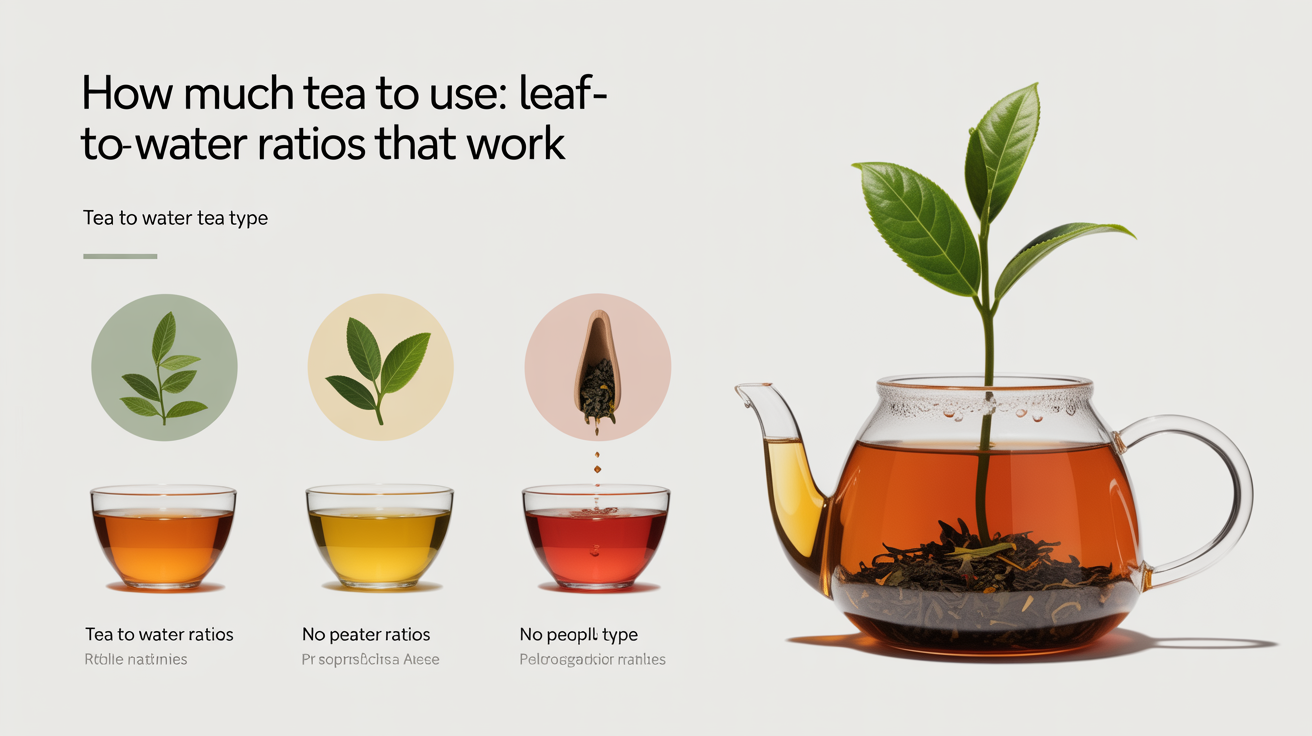
These are western-style baselines for 240 ml (8 oz) of water. They assume a single infusion at the recommended temperature for that style; see water temperature for tea for the full breakdown.
| Tea Type | Grams per 240 ml | Rough Teaspoon Equivalent | Notes |
|---|---|---|---|
| Black (Assam, Ceylon, Darjeeling) | 2.5–3 g | 1 tsp | Darjeeling first flush can go lower, 2 g |
| Green (sencha, dragonwell) | 2–3 g | 1–1.5 tsp | Err lower; over-leafing greens = bitter |
| White (silver needle, bai mu dan) | 3–5 g | 2–4 tsp | Fluffy leaf; needs more by volume |
| Oolong (rolled) | 3–4 g | ~1 tsp | Dense leaf; re-steeps well |
| Oolong (strip/open leaf) | 3–5 g | 2–3 tsp | Lighter, more airy |
| Pu-erh (shou/ripe) | 3–5 g | 1–2 tsp | Compressed; break up evenly |
| Herbal / tisane | 3–6 g | 1–2 tsp | Varies hugely by plant material |
| Matcha (bowl, usucha) | 1.5–2 g | ~1 tsp sifted | Not steeped; whisked in 60–80 ml |
The numbers are starting points. Your water hardness, kettle temperature variation, and personal taste all move the target. Think of the table as calibration data, not rules.
Western vs. Gongfu Ratios
Western brewing uses a larger vessel, more water, and a single long infusion. Gongfu brewing uses a small vessel (typically 100–150 ml), a high leaf-to-water ratio, and rapid successive infusions of 15–45 seconds each.
Western brewing (the default for most people)
Ratio: roughly 1 g of tea per 80–100 ml of water. For a 240 ml mug, that's 2.5–3 g. You steep once at the right temperature for the recommended time and you're done. This approach is forgiving and works well for everyday drinking.
Gongfu brewing (for oolongs, pu-erh, some blacks)
Ratio: 1 g per 15–25 ml of water. For a 120 ml gaiwan or teapot, that means 5–8 g of leaf. The steep times are short (often under 30 seconds for the first few), and good teas can yield 6–12 infusions. The higher leaf ratio isn't a mistake; it's what allows those fast infusions to extract enough flavor without running the leaf dry in one go.
Most people who start with gongfu brewing find the ratios alarming until they realize the vessel is much smaller than a western mug. The cup you pour is 60–90 ml, not 240 ml. Total tea consumed per session is similar; you're just distributing it differently across many small, focused pours.
For steeping times across both methods, the steeping times by type guide has the specifics.
Adjusting Ratios to Your Taste
The ratio interacts with two other variables: temperature and time. Changing any one of them shifts the extraction. Here's how to isolate the ratio when troubleshooting:
If your tea tastes weak or watery:
- Add 0.5 g more leaf next time before adjusting steep time.
- Check that you're using the right water temperature; water that's too cool under-extracts regardless of leaf amount.
- For white teas especially, a "weak" cup often just needs more leaf, not more time.
If your tea tastes bitter or harsh:
- Reduce leaf by 0.5 g and keep everything else the same.
- For green and white teas, bitterness usually comes from too-hot water rather than too much leaf, but overcrowding can compound the problem.
- For black teas, over-leafing combined with a long steep is the most common bitterness cause.
If you want stronger flavor without more bitterness:
- Add more leaf but reduce steep time slightly, or lower the water temperature a few degrees. More leaf at a shorter infusion extracts more aroma compounds and less astringency.
Start with the baseline, brew the cup, make a mental note, and adjust by half-gram increments. Two or three sessions will get you to your personal preference.
Using a Scale: The Fastest Path to Consistent Tea
A kitchen scale that reads to 0.1 g costs $10–20 and removes the biggest variable in home tea brewing. Once you measure your favorite teas a few times, you build a reliable feel for what 2.5 g of your daily Assam looks like in the palm of your hand. At that point you don't need the scale for every cup; you've just calibrated your intuition.
A practical setup
- Place your empty strainer basket or infuser on the scale and tare it.
- Add leaf until you hit your target weight.
- Put it in the vessel, pour water at the right temperature, steep, done.
This takes about 10 seconds longer than eyeballing it. The upside is that every cup you make is reproducible. When you try a new tea and it's not working, you know immediately it's not a measurement error.
If you don't own a scale yet, round teaspoon measurements with the density guide above will get you close enough to start. But if you're serious about dialing in different teas across your collection, measuring grams per cup is the single highest-return adjustment you can make.
Frequently Asked Questions
How much loose leaf tea per cup as a general rule?
For a western-style cup (240 ml / 8 oz), start with 2–3 grams of loose leaf tea. White teas and large-leaf oolongs need more by weight (3–5 g) because the leaf is light and airy. Dense rolled oolongs and CTC black teas sit at the lower end of that range.
Can I use a teaspoon if I don't have a scale?
Yes, with caveats. One level teaspoon works reasonably for orthodox black teas and medium-density greens. For fluffy white teas, use 2–3 teaspoons for the same amount of flavor. For dense rolled balls, a single teaspoon may be enough or even slightly over. The density guide in the table above is your reference.
What happens if I use too much tea?
With black tea, you get more astringency and bitterness, especially if the steep time is also long. With green tea, bitterness and a slightly vegetal edge appear. With white tea, "too much" mostly just makes a more full-bodied cup rather than a harsh one. Pu-erh and aged oolongs are fairly forgiving even at higher ratios.
Is the tea to water ratio different for cold brew?
Yes. Cold brewing is slower and less efficient at extraction, so you need more leaf: typically 1 g per 40–60 ml of cold water, steeped 8–12 hours in the refrigerator. Ratios vary more by tea type here than in hot brewing, so it's worth experimenting with your specific teas.
Does water quality affect how much tea I should use?
Hard water (high mineral content) extracts differently and can make tea taste flat. If you're on very hard tap water, you might find yourself using slightly more leaf to compensate. Filtered or low-mineral water is generally the easier fix; it lets the tea's own flavor come through at standard ratios without adjustment.