Matcha & Whisked
How to Whisk Matcha Without Lumps
Stop clumpy bowls for good. Learn the right sifting, water temp, and chasen technique for perfectly smooth matcha every time.

Lumpy matcha usually comes down to two things: skipping the sift and whisking with the wrong motion. The powder clumps on contact with water before you even pick up the chasen, and then stirring the surface does nothing to break them up. Both problems have simple fixes, and once you understand the mechanics, smooth matcha takes about 90 seconds.
This guide covers everything from why matcha clumps to how to revive a bowl that's already gone wrong. If you're still working out the basics of the preparation itself, the how to make matcha guide is a good starting point before you come back here for the whisking specifics.
Why Matcha Clumps in the First Place
Matcha is ground to a particle size of around 5-10 microns. At that fineness, the particles carry a small static charge and cling to each other, forming clusters that can survive a full minute of whisking if you don't address them before adding water.
Humidity makes this worse. A bag opened and resealed a few times, or stored in a humid kitchen, will clump more readily than fresh powder. Temperature matters too: particles that have been sitting in a cool tin and then hit warm water tend to form a skin on the outside of each cluster, trapping dry powder inside.
The role of water temperature
Water above 80°C denatures some of the amino acids in matcha and accelerates clumping. Water below 65°C makes the powder harder to hydrate fully. The sweet spot for whisking is 70-75°C. If you don't have a temperature-controlled kettle, boil and leave the water to sit uncovered for 3-4 minutes.
Sift First, Every Time
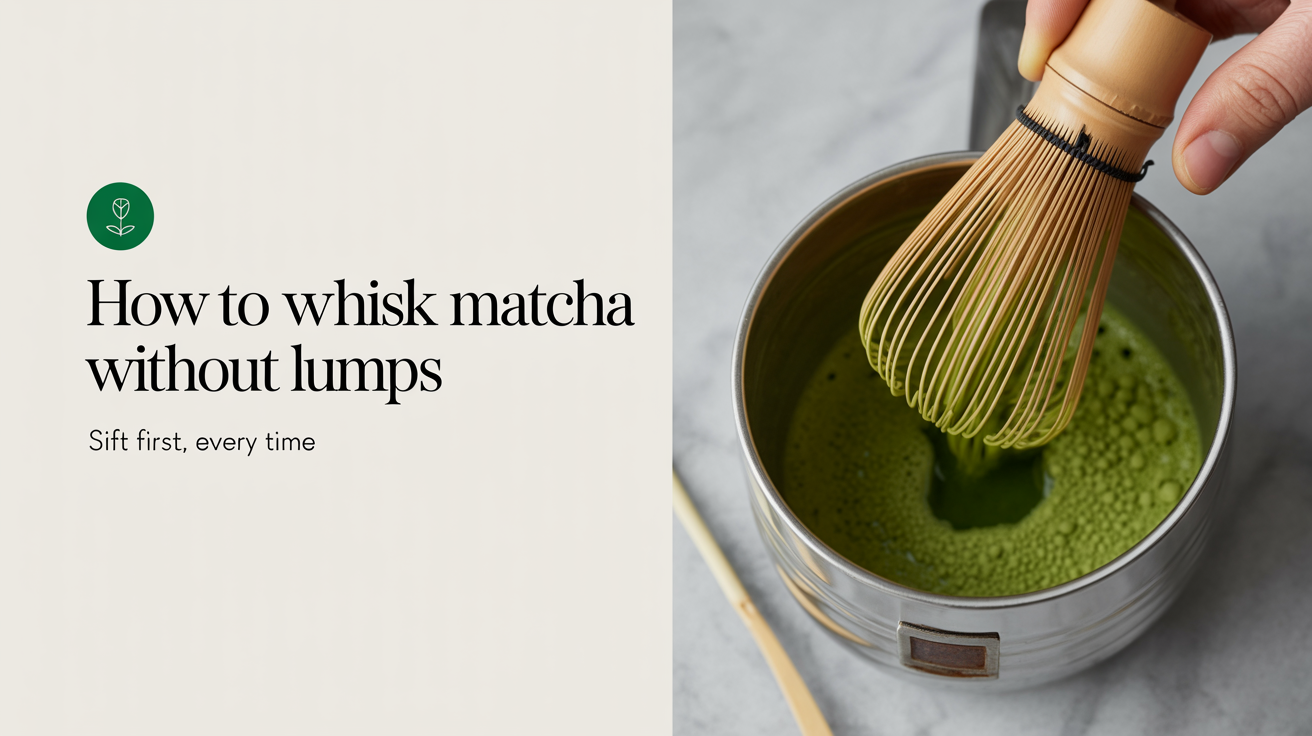
Sifting is the single highest-impact step for lump-free matcha. It takes 10 seconds and a fine-mesh sieve (80-100 mesh works well; a tea strainer over the bowl is fine in a pinch).
Steps:
- Set a fine-mesh sieve over your chawan or bowl.
- Measure 2g of matcha (roughly 3/4 teaspoon) into the sieve.
- Use the back of a spoon or a small spatula to press the powder through.
- Tap the sieve lightly if powder catches on the mesh.
- Discard any large clumps that won't pass through.
The sifted powder should look like a small pile of fine green dust. If it's still clumping in the bowl before you add water, your storage conditions need attention. Keep matcha in an airtight tin, away from light and moisture, and ideally use it within 4-6 weeks of opening.
How to Use a Chasen Correctly
A chasen is a bamboo whisk with anywhere from 60 to 120 tines. The tine count affects the foam texture (more tines, finer bubbles) but the motion is the same regardless.
The W or M motion
The most common mistake is stirring in circles. Circular motion pushes the powder around the bowl without aerating it. The correct matcha whisking technique is a rapid back-and-forth movement: draw the chasen across the bottom of the bowl in a W or M shape, working from one side to the other.
Keep your wrist loose. The motion comes from the wrist joint, not the elbow. Your arm stays mostly still; your wrist flicks back and forth at roughly 3-4 cycles per second. Think of it less like stirring and more like scrubbing a very small surface.
How to add the water
Add the water before you start whisking, not after. Pour 60-70ml of 70-75°C water directly onto the sifted powder. Some people add a few drops first, make a paste, then add the rest. The paste method gives slightly more control over hydration if your powder is old or particularly clumpy, but it's not necessary with fresh matcha.
The full whisking sequence
- Sift 2g matcha into the chawan.
- Pour 60-70ml of 70-75°C water over the powder.
- Hold the bowl with one hand, chasen vertical in the other.
- Start the W/M motion at the bottom of the bowl, brisk and light.
- After 20-25 seconds, lift the chasen slightly toward the surface to build foam.
- Reduce speed for the final 5 seconds to smooth the top layer.
- Lift the chasen straight up from the center of the foam.
The whole whisking phase should take 30-45 seconds. Longer than that usually means either the powder wasn't sifted or the water was too cool.
How to Tell When It's Done
Properly whisked matcha has a layer of fine, even foam across the surface. The bubbles should be tiny, around 1-2mm, and consistent in size. Large uneven bubbles mean you stopped too soon or the motion was too slow. A flat surface with no foam at all usually means the chasen barely contacted the liquid.
The color should be a uniform bright green with no visible dark streaks or patches sitting on the surface. Tilt the bowl slightly; the liquid should move smoothly without revealing dry powder stuck to the edges.
Fixing a Clumpy Bowl
Sometimes you realize after the first sip that lumps survived the whisk. A few options:
Re-whisk: Add another 10-15ml of hot water, re-whisk briefly with the W/M motion. This often dislodges surviving clusters.
Strain it: Pour the matcha through a fine sieve into a second cup. You lose a little volume but the result is perfectly smooth.
Prevention for next time: If you're using ceremonial vs culinary matcha, culinary grade tends to have coarser particles and clumps more easily. Sifting is non-negotiable with culinary grade; it's advisable even with ceremonial.
Troubleshooting table
| Problem | Cause | Fix |
|---|---|---|
| Large lumps after whisking | Skipped sifting | Sift first; strain the current bowl |
| Foam collapses immediately | Water too hot (above 80°C) | Cool water to 70-75°C before pouring |
| Thin, watery texture | Too much water or too little powder | Use 2g matcha to 60-70ml water |
| Powder sits on surface | Wrong whisking motion (circular) | Switch to W/M back-and-forth from wrist |
| Bitter, dark green result | Old or low-quality powder | Use fresh ceremonial grade within 6 weeks of opening |
| Grainy texture in every batch | Chasen tines worn or bent | Soak chasen 2 minutes before use; replace worn chasen |
Caring for the Chasen
A well-maintained chasen lasts longer and produces better foam. Worn or misaligned tines produce larger, uneven bubbles and don't reach the bottom of the bowl properly.
Before each use: Soak the chasen tip in warm water for 1-2 minutes. This softens the bamboo and makes the tines more flexible, which reduces breakage and produces finer foam.
After each use: Rinse under warm (not hot) water while gently swishing the tines with your fingers. Do not use soap. Set it upright on a chasen holder (kusenaoshi) or rest it tine-side up to dry. Never store it flat with tines pressed against a surface.
Replacing it: A chasen doesn't last forever. When more than 3-4 tines are broken or the central ring starts to unravel, it's time for a new one. A 80-tine chasen runs $8-15 and is worth replacing rather than nursing along. A broken tine in your bowl is unpleasant to drink.
If you prepare matcha regularly but don't own a chasen, the matcha without a whisk guide covers workarounds. But for daily use, the chasen is worth the investment; nothing else produces the same foam.
Frequently Asked Questions
Why is my matcha clumpy even after whisking for a long time?
The most likely cause is that you didn't sift the powder before adding water. Once dry matcha clumps touch water, the outer layer hydrates and seals the dry interior. Longer whisking won't fix that; the cluster needs to be broken up before any moisture reaches it. Sift next time, and strain the current bowl if you want to salvage it.
How much water should I use for whisking matcha?
The standard ratio is 2g of matcha to 60-70ml of water for usucha (thin tea). This produces a drinkable, moderately foamy bowl. For koicha (thick tea), use 4g to 30-40ml and knead rather than whisk. Most home preparation is usucha, so 60-70ml is the right target.
Can I use a regular whisk instead of a chasen?
A small metal balloon whisk can break up clumps, but it won't produce the fine foam a chasen creates because the wire geometry is too coarse. It also tends to scratch ceramic bowls. If you need a workaround for occasional use, a milk frother works better than a balloon whisk. For regular matcha preparation, a chasen is the right tool.
What temperature should the water be for whisking matcha?
70-75°C is the target. Above 80°C you start degrading the amino acids (including L-theanine) that give matcha its characteristic flavor, and the foam structure suffers. Below 65°C the powder doesn't hydrate fully. If you don't have a temperature-controlled kettle, boil water and let it rest uncovered for 3-4 minutes, which typically drops it to around 80°C, then another 1-2 minutes to reach 75°C.
How do I know when my chasen needs replacing?
Check the inner tines after each use. If 3 or more are broken, bent inward and not springing back, or if the binding ring is starting to separate, it's time for a new one. A damaged chasen produces uneven foam and the broken tines can end up in your bowl. They're inexpensive; replacing a worn chasen is easier than working around one.